


The year 2015 marked a new progress of provincial education – training (ET) sector. The sector fulfilled goals and targets of educational development, major campaigns, sustainable development of educational quality. These 9 below highlights brought a panorama of provincial ET sector in 2015.
Meeting the learning needs of all students
Every year, the province has more tens of thousand students of all levels. Only in 2015, the province had nearly 351,000 students at all levels, which was 31,000 students higher than 2014. However, in order for all students to go to school, the sector made efforts to overcome difficulties, coordinated with localities to resolve shortages of material facilities, teaching equipment to meet the learning needs of students.
Nationally standardized school rate meets Resolution’s target
According to statistics, by the end of Sep 2015, the province had 201 schools meeting national standards. Compared with the number of public schools registered at beginning of the tenure (in 2010) reached 198/314 schools or 63.1%, meeting the 9th Provincial Party Resolution’s target.
Heightening teacher’s standard
In 2015, ET sector focused on improving professional standards of management staff and teaching staff. As a result, 99.91% management staff achieved standard qualifications, 83.04% management staff were above standard. There were 12,703 teachers, including 99.58% meeting standard qualifications and 65.41% achieving above standard.
Ministry of Education commended Department of Education and Training for good works on staffing and personnel training in the 2014-2015 school year.
Educational quality develops sustainably
At the primary level, 98% students moving up and 98% students completing primary education. 53.7% secondary-school students were rated moderately good and good. 51.2% high-school students were rated moderately good and good.
Provincial high school graduation rate is higher than national rate
In 2015, there was a major change in examination. Ministry of Education and Training arranged a general examination, and the test results were used for high school graduation and university – college admission. In Binh Duong, 7,096/7,471 contestants completed high school graduation in the 2014- 2015 school year, achieving 94.88%, being 1.35% higher than the national rate, and including 5/32 schools obtaining 100% high school graduation rate.
University admission rate in 2015
In 2015, the province had 6,737 candidates applying for the university and college entrance exam out of 7,096 high school graduates, achieving 94.94%. Among these, 4,329 candidates admitted to the universities (64.26%). Total candidate number admitted to universities and colleges (public and private) were 5,273 candidates (78.27%).
Maintaining the quality of literacy, education universalization, preschool education universalization
- 9/9 units at district level achieved preschool education universalization standards for 5-year-old children; 90/91 communes, wards and towns reached the standards (98.9%).
- 9/9 units at district level achieved national standards of literacy; 6/9 units met level-1 literacy standards, 3/9 units met level-2 literacy standards.
- 9/9 units at district level achieved national standards of primary education universalization; 2/9 units met level-1 primary education universalization standards; 6/9 units met level-2 primary education universalization standards; 1/9 unit met level-3 primary education universalization standards.
- The province continued to maintain 100% of districts, towns and city to meet primary education universalization standards.
- 9/9 units at district level achieved secondary education universalization standards.
- The province had 83/91 recognized communal units achieved secondary education universalization standards (91.21%).
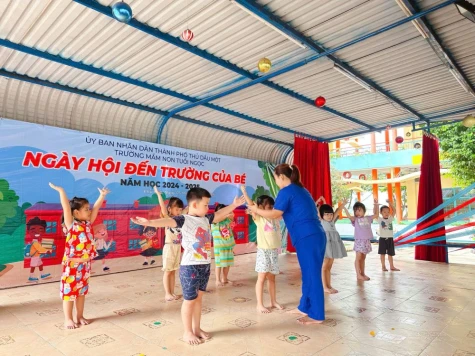
Socialization of preschool education
In 2015, socialization of preschool education kept spreading; inspection and supervision at preschools was seriously carried out to ensure the quality of childcare and safety.
Enhancing educational socialization
In 2015, educational socialization was intensified; more and more resources have invested in education and training, thereby contributing to improving educational quality at all levels.
Compiled by H.Thai – Translated by Ngoc Huynh