Paul Reed, a Vietnam War veteran, returned a wartime diary he had kept since the 1960s to its author, a Vietnamese soldier, and said the book helped him escape the haunting ghost of an unjust war.
Nearly forty years have passed, but many US veterans are still plagued by the atrocities of the Vietnam War. Many returned home with post-traumatic stress disorder (PTSD) and struggled to adjust to civilian life, searching for inner peace, empathy and forgiveness.
Paul Reed is among hundreds of those US soldiers who has finally received such empathy.
In a room filled with war memorabilia, in McKinney, a small town in the US state of Texas, a man was sitting in front of a computer, with his eyes glued to the screen.
Horrific memories of military operations and fierce battles more than 40 years ago seemed to flood back, and they would probably reverberate throughout the rest of the life of the veteran who joined the Vietnam War in the late 1960s.
Paul said he could not forget the disturbing images of the brutal war which have haunted him every night for the past 46 years.
In 1966, Paul, 17, volunteered for US military forces fighting in Vietnam, bursting with patriotic pride. He eagerly took part in arduous military training, paying no heed to warnings from ex-soldiers returning from Vietnam.
When joining the army, he registered for position of a paratrooper, but nobody warned him he would have to take up arms and fight. Later fierce fighting in Vietnam is a poignant reminder of the terrible war.
Paul joined Brigade 173 and was sent to Bien Hoa in March 1968 where he met an old American friend who had fought in Vietnam for six months. The friend felt sorry for him, explaining Paul would have to shoot and kill people.
Shortly after arriving in Vietnam, Paul was dispatched to the Kon Tum battlefield in the Central Highlands, where he experienced his first dark days of the unjust war.
His unit marched during daylight and slept in the forest at night, facing grave threats from snakes, centipedes, mosquitoes, and heavy forest rain. It was here, Paul witnessed the US troops’ utter boredom of the war.
In a hilltop raid, one of Paul’s soldiers was seriously wounded, as he slipped in and out of consciousness he wished he would return home sooner and meet his parents.
The soldier’s last words before he breathed his last echoed in Paul's mind as an evil omen of an unforeseeable return. Paul gradually realised that he and his teammates had fallen victim to the US administration’s shooting game.
In a fierce battle, Paul’s unit faced a heavy loss and had to change tactics in an attempt to occupy the top of a hill, which was in the hands of Vietnamese soldiers.
Paul and several soldiers were assigned a scouting task and they discovered a camp of Vietnamese soldiers with over 50 backpacks, weapons, cooking pots, medical equipment, and first-aid bandages
When searching a backpack, Paul found two Vietnamese flags, stamps, money, photos, pieces of newspapers, and particularly a diary. He decided to hide all the items and send them to the US to avoid foreclosures.
That night, Paul packed a cardboard box in the form of a parcel and asked a helicopter pilot in person to transport the parcel back to the US and send it to his parents. Although the deal was done, he still felt uneasy about it.
To his surprise, he received a letter from his mother ten days later, notifying him the parcel had arrived. However, Paul did not have much time to dwell on the news; he had to fight constant battles in central Vietnam, suffering harsh weather, extreme heat during daytime and bitter cold at night.
Paul eventually left the army and returned to the US after a year in Vietnam. He was told that the war had ended and that he should forget it.
He finally found a job but often felt anger towards his colleagues. After numerous quarrels and fighting, Paul lost everything, from his job to property and family.
Eighteen years after returning from the Vietnam War, Paul knew he suffered from post-traumatic stress disorder. He moved to live with his parents who were not able to explain why the enduring memories of the Vietnam War remained fresh in their son’s mind though he had left the army for nearly 20 years.
During a dinner, Paul’s mother reminded him of the parcel she had kept in the attic for nearly 20 years – the parcel Paul intended to throw it away, believing it to be rubbish.
He opened the box and found the diary with Vietnamese handwritings. His mother said she would find someone to translate the diary in the hope it could help to change his son’s life.
After translating the diary, the translator, a former Saigon regime officer, told Paul, “Paul, I also hate this man like you, but I must say this is a really good man.” Paul replied in anger, saying it was not a good man who killed his soldiers.
Paul brought home the translation, threw it on the table and did not look at it anymore. A few months later, he almost went crazy. In an angry squall, he raised his fist to the sky, screamed and wondered who got him into such a terrible mess.
By the time he realised God had arranged everything for him. He lost everything that God had given him.
Looking around, Paul by chance came across the diary on the table which contained verses about the homeland, love affairs, nostalgia for home and family, and the desire for national unification.
Within moments, Paul felt an empathy with the foe, a Vietnamese soldier, Lieutenant Nguyen Van Nghia, the author of the diary. He believed he and Nghia were one, without confrontation and hatred.
Paul thought that Nghia was also a human being and he fought for national independence. He was aware that revenging Nghia meant revenging himself, and forgiving Nghia also meant forgiving himself.
Paul shouted, “I will forgive you, I will forgive you”. He felt as if he had escaped the haunting ghost of the past war. He burst into tears, raising a number of Why questions like “Why was he killed?”, “Why did we kill him?”, “Why did I kill him?.” He thought that killing Nghia meant killing himself.
Though Paul had not met Nghia before, in his mind, they had an affinity. Paul repeatedly read the diary day by day and wished Nghia was still alive to receive his sincere thanks.
Three years later, Paul decided to return to Vietnam and hand over the diary to Nghia’s wife to pay his gratitude to the Vietnamese soldier who helped change his life.
One day, before his return to the former battlefield, Paul found out Nghia was alive. He was so moved that he broke down in tears. He counted down the time when he could meet Nghia again.
Finally, the two former foes met each other on a wintry day in 1993 in Nghia’s house in Thai Binh province, not far from Hanoi capital. Beyond his expectations, he was welcomed in a sincere, open, friendly and hospitable manner.
Paul handed over Nghia’s memorabilia he had kept as his own, and the following day the two visited the former battlefield in Kon Tum province.
“I told Nghia I hated him because he had killed my friends. I also hated Vietnam,” Paul recalled. “Nghia said he also hated me because he had lost most of his friends and his younger brother who laid down their lives on the battlefield. He said I had killed them…..”
Paul said he had forgiven Nghia, and wondered if Nghia could forgive him. Nghia replied, saying “let’s break with the past”.
They shook hands, going down the hill where they pointed the guns at each other 25 years earlier. They felt the war has actually come to an end and they could finally lay it to rest.
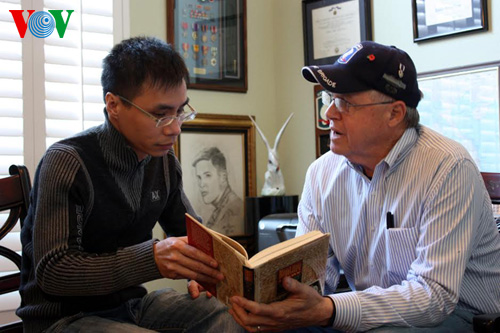
Paul Reed shows the diary to Nhat Quynh, a Washington-based VOV correspondent
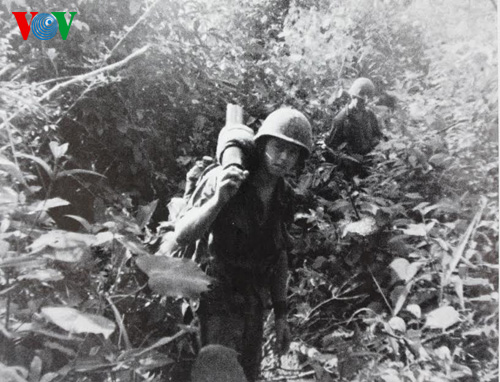
Paul Reed in the Kon Tum battle field
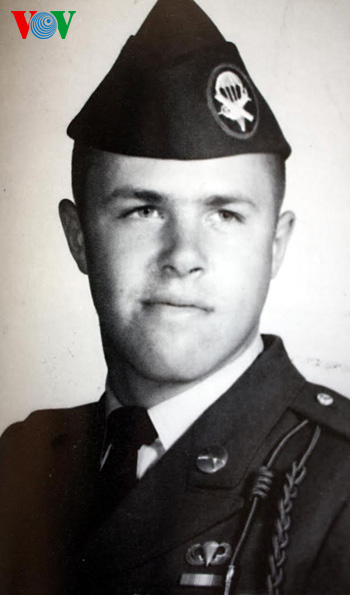
Paul Reed in 1967
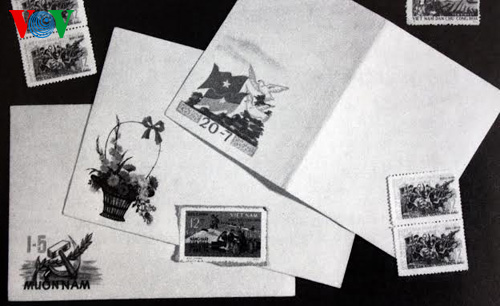
Stamps and envelopes found in the backpack
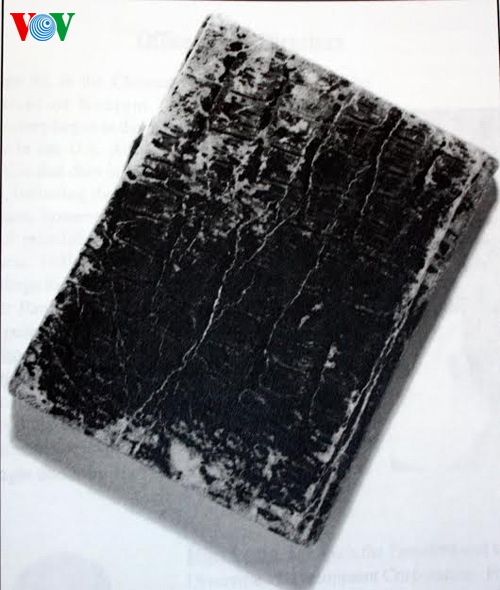
The diary kept in the cardboard box in Paul's attic
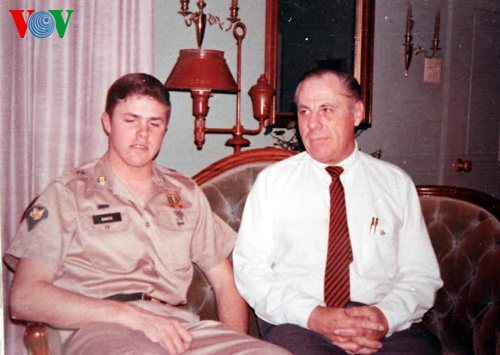
Paul (L) and his father before returning to Vietnam
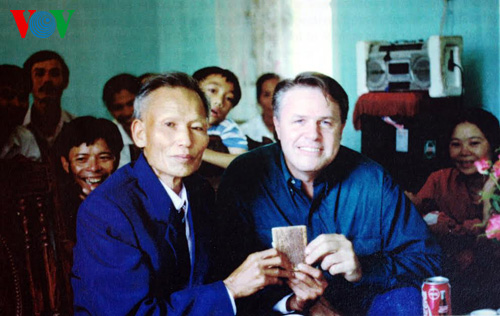
Paul handed over the diary to Nghia during his trip back to Vietnam
VOV