


Social Insurance (SI) is one of the policies contributing to securing social security. Therefore, all levels and sectors in the province, especially provincial SI, have carried out several measures to reduce social insurance arrears and take better care of employees.
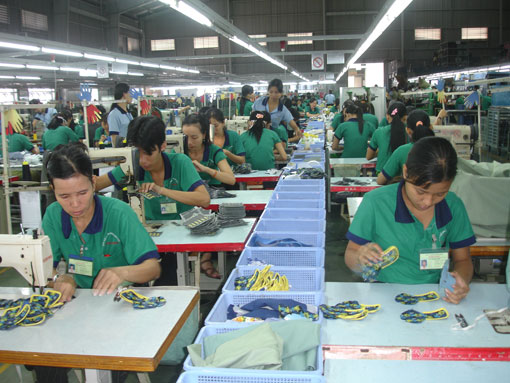
Implementing well policies to consolidate employee’s commitments to their organization. Photo: Workers of Dong Hung company were working zealously in working hours
Declining debt ratio
Currently, the province has 1,572,223 people in working ages, the number of agencies and units, businesses employing labors are 13,531 with a total of 992,365 employees. According to statistics until Sep 2016, the total number of agencies, organizations and enterprises in the province joined compulsory social insurance, unemployment insurance (UI) was 7,700. By the end of Aug 2016, total debt of SI, UI, and health insurance (HI) was more than VND782 billion.
According to provincial SI officials, right from the beginning of the year, when receiving the assigned revenue estimates, provincial SI assessed the feasibility of each district, town and city on basis of the previous year, the possibility to develop subjects, increase revenues in order to allocate the revenue plan. Especially, the effectiveness of propaganda and dissemination of policies and laws on SI, UI, HI among sectors, unions have helped agencies, units and enterprises better abide by regulations, care more about employee benefits.
Debt collection works were taken seriously, regularly. During the first 9 months of 2016, sectors examined 315 units, enterprises in the province. Provincial SI also actively advised, implemented measures such as: sending emails, making phone calls to remind of debts below 2 months; sending document to debts of 2 months or more. After 2 times of sending document (each separated by 15 days) but the debt is still not paid, a minute will be established to request debt confirmation and payment schedule.
However, because small- and medium-seized enterprises are facing some difficulties in production, payment process of insurance premium is slow, thus regimes are not settled timely for employees. Conventionally, by the end of each quarter, HI cards have to be renewed. Businesses have to pay off insurance debts to get new HI cards. According to statistics, total HI debt from 1 to 3 months is more than VND521 billion, accounting for 66.6% of total debt. But by the end of the quarter, the debt would decrease, because businesses will pay off debts to get HI cards.
Satisfactorily settling regimes for employees
Since 2015, provincial SI has advised provincial People's Committee to direct employers to transact all dossiers by mail and apply electronic transactions in order to simplify SI administrative procedures, save time, costs for employers and employees. Payments are made on schedule and very quickly. Payment methods and staff qualifications meet all requirements of payment work.
The process of receiving, settlement of SI regimes for employees is in compliance with regulations of Vietnam Social Insurance. Due to shortened turnaround and settling time, administrative procedure settlement is shortened, such as: Settlement time of retirement allowance is 15 days, SI book adjustment is 10 days. To reduce the flow of people coming SI agencies, provincial SI has applied lump-sum payment of SI allowances by mail.
Payment of sickness, maternity regime is done through the employers. Specifically, after the evaluation and approval, SI agencies will transfer the approved money to the employers. After receiving money and the list from SI agencies, employers will pay their employees. From Oct 2016, provincial SI has piloted sickness, maternity allowance payment through employee’s account at 15 units.
Evaluating the implementation of social insurance law in the province, Mr. Mai Duc Chinh, Vice President of Vietnam Labor Confederation, praised the implementation of SI laws in the locality. However, all levels and sectors in the province need to be more aggressive in SI arrear collection, increase SI premiums for employees, actively carry out synchronous solutions, contributing to ensuring social security.
Reported by Kim Ha – Translated by Ngoc Huynh