


Throughout the national resistance wars, the people and armed forces of Ben Cat, under the leadership of the Communist Party, overcame countless hardships to achieve resounding victories. These efforts significantly contributed to the overall success of the country's struggle for independence and national reunification. Today, continuing the proud revolutionary tradition of their homeland, the Party, government and people of Ben Cat city are united in harnessing the region’s potential and advantages, determined to transform this historically rich land into the “golden haven” as once envisioned by former General Secretary Nong Duc Manh during his visit to Ben Cat.
Transformation in “Iron Triangle” homeland
During the two wars against colonial and imperial forces, Ben Cat served as a cradle of revolution and a vital base of resistance. This land was home to the Long Nguyen War Zone, established in the early days of the resistance against French colonialism in 1946. Long Nguyen served as a strategic link in the interconnected chain of revolutionary strongholds, including War Zone D, Duong Minh Chau and Vinh Loi. Thanks to its strategic location, throughout the two resistance wars, Long Nguyen was the operational hub for key revolutionary leadership bodies such as the Eastern Region Committee, Gia Dinh provincial Party Committee, Thu Dau Mot provincial Party Committee, Ben Cat district-based agencies, along with various armed forces. Every location within Long Nguyen bears the legacy of heroic and resilient battles fought by the people and liberation troops — a testament to the unyielding spirit of the revolution.
Together with the Long Nguyen War Zone, the tunnel network of the three southwestern communes (An Tay, An Dien and Phu An) — also known as the "Iron Triangle Tunnels" — is a renowned historical site associated with the glorious victories of our military and people during the years of arduous and fierce resistance. Throughout the 20-year war against the American imperialists, the local armed forces and people of the three southwestern communes relied on this intricate tunnel system to bury thousands of enemy troops and destroy hundreds of tanks and armored vehicles. Especially during in the 1968 Spring General Offensive, Uprising and 1975 Spring Offensive, the Iron Triangle Tunnels served as a key gathering point for major revolutionary forces before launching decisive attacks on Saigon, significantly contributing to the national victory in 1975.
After the country was reunified, just like the rest of Vietnam and the former Song Be province (now Binh Duong), the people and armed forces of Ben Cat — homeland of the Iron Triangle Tunnels — stood united to overcome hardship and gradually rebuild their homeland from the devastation of war. Fifty years since the liberation of the South and the reunification of the nation, Ben Cat city in general and the area of the three southwestern communes in particular, have undergone remarkable changes. An Tay and An Dien have been upgraded to wards, experiencing rapid urbanization and industrialization. Phu An commune has soon become a new-style rural commune, then an advanced new-style rural one and is striving to achieve all the criteria of a model new-style rural commune.
Though the years have passed and the war has receded into history, the resounding victories and great sacrifices of the people and armed forces from the homeland of the Long Nguyen war zone and the Iron Triangle Tunnels continue inspiring today’s generations with a steadfast resolve to build a prosperous, civilized and affectionate Ben Cat — a land forged in revolution.
Continuing the song of triumph
In response to the Party’s policy of comprehensive national renewal and the pursuit of industrialization and modernization, Binh Dương province has quickly transformed its economic structure and strongly attracted investment for industrial development. Numerous industrial zones and clusters were established, drawing many domestic and foreign enterprises. Thanks to this momentum, the province’s economy has experienced rapid growth, urbanization progressed at a strong pace and Binh Duong has emerged as one of the fastest-growing localities in the Southern Key Economic Region.
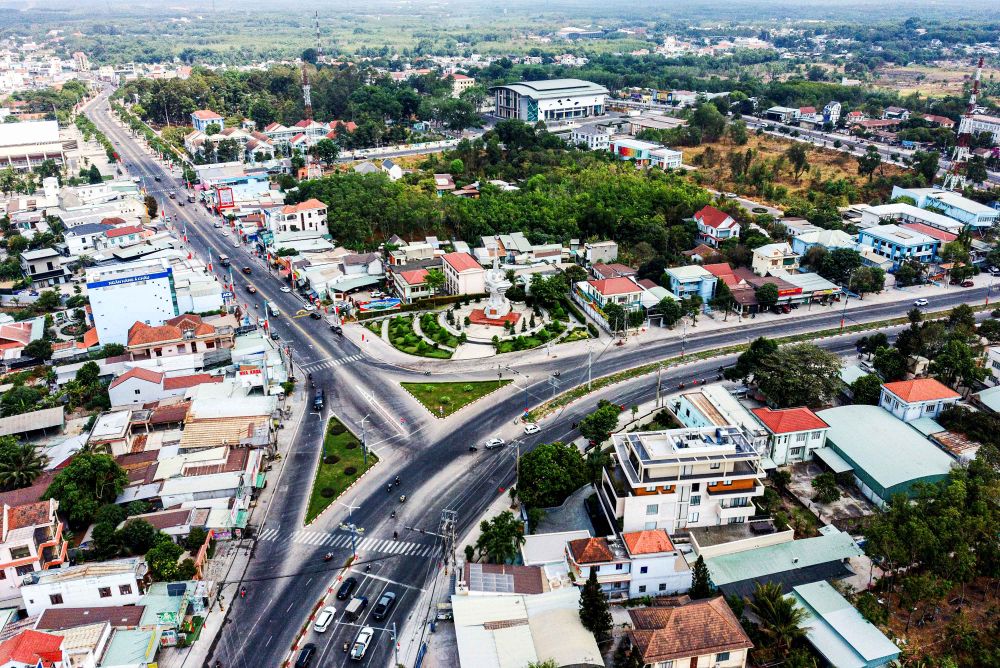
Compared to southern localities of the province such as Thu Dau Mot, Di An and Thuan An, Ben Cat was slower to start in industrial development. However, leveraging the advantage of being a later entrant, Ben Cat was systematically planned by the province for industrial expansion with well-organized industrial parks, clusters and modern, well-developed new urban areas. Under the provincial policy to promote industrial development in northern districts, several modern industrial parks, namely My Phuoc 1, My Phuoc 2, My Phuoc 3 and Viet Huong 2 were established. As these industrial parks came into operation, Ben Cat has quickly become a key destination for both domestic and international enterprises. Currrently, the city is home to 8 industrial parks covering a total area of over 4,000 hectares and one centralized production zone spanning nearly 50 hectares. By the end of 2024, Ben Cat city had attracted more than 7,000 investment projects from both local and foreign investors.
Along with the development of a modern and well-planned industrial infrastructure system, Ben Cat city has also seen strong investment in its transportation system in recent years. The city is now well-connected through key routes such as National Highway 13, provincial roads 741 and 744, the My Phuoc – Tan Van expressway, belt road 4 and an expanding network of inner-city roads. They have provided highly favorable conditions for Ben Cat to easily connect with industrial parks and urban areas in the southern part of the province as well as with Ho Chi Minh city and Binh Phuoc province. A synchronized traffic system not only enhances connectivity, playing a crucial role in boosting socio-economic development, attracting investment, promoting industrialization and modernization, ensuring national defense and security in the province and the Southern Key Economic Region.
Along with economic growth, the fields of education, health care and urban rejuvenation have all received synchronous investment and achieved many positive results. Throughout its development journey, the Party Committee and government of Ben Cat city have consistently prioritized people and businesses, using industrial development as a driving force for urban growth, service expansion and support for agriculture and other sectors. This comprehensive approach is clearly reflected in the city's increasingly bright, green, clean and beautiful urban image.
If in the two resistance wars against foreign invaders, Ben Cat was known as a land rich in revolutionary traditions with names of lands and villages that were steadfast in the face of bullets, bombs, and fire, today, on that same land, successive generations have joined hands to create miracles in building and developing their homeland. This heroic land is continuing writing new, radiant and glorious victories—worthy of the great sacrifices made by previous generations, who shed their blood so that this once “fiery land” could rise and thrive in the new era.
In line with the province's policy of promoting industrial development in northern districts, modern industrial parks, namely My Phuoc 1, My Phuoc 2, My Phuoc 3 and Viet Hung 2 have been successively established. With these industrial parks going into operation, Ben Cat has quickly become a key area attracting domestic and international enterprises. As of now, the city has had 8 industrial parks with a total area of over 4,000 hectares, along with a centralized production zone spanning nearly 50 hectares. By the end of 2024, Ben Cat city attracted over 7,000 investment projects from domestic and foreign investors.
Reported by Tri Dung-Huu Tan-Translated by Kim Tin