

To improve educational quality, in recent years, provincial educational – training (ET) sector has given 2 sessions / day at all school levels and boarding meals for students. For the health of students, competent authorities have strived to assure food safety and hygiene (FSH) in schools.
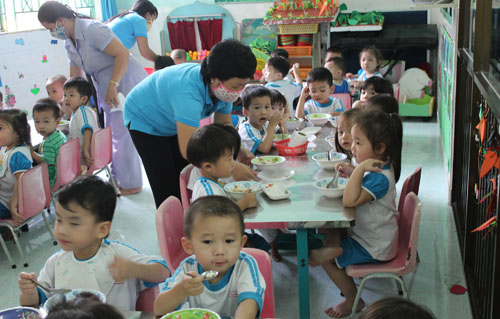
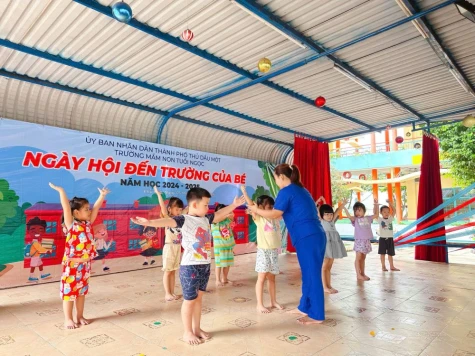
Lunch time at a kindergarten in Di An town
The province has 100% pre-schools, 95 primary schools, 14 secondary schools giving boarding meals. Although there has been no sectorial FSH steering committee, ET leaders are members of provincial FSH steering committee, and identify the FSH assurance in boarding schools is an important task. Nguyen Hong Sang, Director of provincial ET Department, said the department has actively coordinated with health sector to give training of legal documents to their staff.
The sector has also innovated propaganda and communication activities to parents and community… Particularly, inspection and administration are performed regularly and periodically in order to catch the situation of using food, organization procedures of boarding and FSH assurance activities at ET facilities in order to detect weaknesses, deficiencies and timely put forward solutions, support ET facilities. Besides, the sector has joined hands with localities to take measures to tackle facilities not complying with common regulations, affecting negatively student’s health.
Right from early ages, if children are well nurtured and cared, they will grow up well physically and intellectually. In addition, FSH issues are also important factors affecting largely children’s health. Caring care for the future generation is the responsibility of the whole society, and need more efforts from many sectors. FSH branch office has realized measures to improve the effectiveness of FSH administration. According to Tran Minh Hoang, FSH branch office, since 2010, the health sector and ET sector in the province have organized commitment signings of preventing food poisoning with boarding schools and boarding meal suppliers; schools giving boarding meals also established autonomous FSH groups.
Currently, 100% schools organizing collective kitchens established autonomous FSH groups. 2 units also jointly organized training courses to ensure 100% autonomous groups received FSH professional instructions. FSH branch office and ET sector hold annual workshops to improve the canteen, collective kitchen organization and recommend the application of advanced quality management system.
In addition to ensuring FSH at canteens, food safety issues have a more important meaning. According to Dinh Thien Thuan, Director of Quality Management Office under Department of Agriculture and Rural Development, food safety assurance should be performed right from input materials, processing and preservation, human factors. Schools need to control the input materials; control processing and preservation. Units should choose qualified and healthy people to be in charge of the kitchen. This team should be regularly trained and updated on food safety information and ensure personal hygiene during the processing.
Nevertheless, there are still some difficulties. Most schools do not have enough medical staff. Educational facilities encounter difficulties in identify the food source from suppliers. Staff is not stable due to low wages. Some localities do not really care about school boarding and FSH…
FSH branch office believed that ET sector needed further investments in school canteens, namely, sanitary conditions, equipment, utensils, kitchen design…; heightening Enhancing the role and responsibility of parents in FSH supervision. Kitchens should invest in rapid tests of input materials. The province should support the health sector in scientific research, quality evaluation of nutrition, food safety at school kitchens, canteens, especially at preschools…
Reported by H.Thai – Translated by Ngoc Huynh