


To solve overload at state-run nursery schools, mobilizing different sources in the society to develop schools and expanding private nursery schools are an urgent issue. However, the form of education socialization, especially in nursery schools has showed many problems. Companies should actively develop nursery schools right at their unit to bring secure feeling for workers.
According to the provincial department of Education and Training, the province has additional about 5,000 children per year. With the huge increase, the state-run nursery schools have not satisfied parents’ demand on baby-sitting. At present, the entire province has had 265 state and licensed-private nursery schools and 157 unlicensed private nursery classes. In reality, the number of unlicensed nursery classes is very huge under the form of household-run nursery classes next to boarding rooms. With a low income, workers have to send their children to unlicensed household-run nursery classes, owing to cheap tuition.

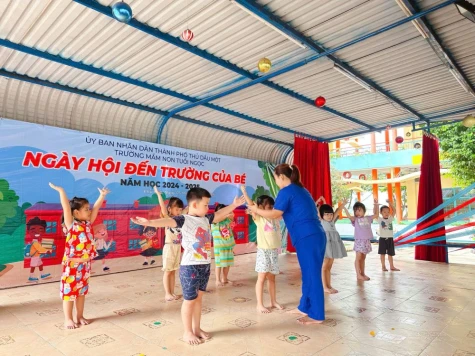
Children at Huong Duong nursery school.
As stipulated, household-run child care classes and private nursery schools are managed by state-run nursery schools. But in reality, management is not conducted closely. A maltreatment for a three-year-old girl in Thuan An district at an unlicensed household-run nursery class made the opinion angry. In Binh Duong, while industrial parks, factories have sprung up like a mushroom, child care centers for workers’ children are not much paid attention. As the result, the only choice for workers is to bring their children to privately run classes, where there are only one “teacher” and several “pupils”. Besides, women only have a 4-month maternity leave while child care centers do not receive children under 18 months old.
All the districts and towns in the province have industrial zones, attracting countless female workers in childbirth age, so the serious overload of pupils at pre-schools in major localities across the province has become a problem. However, there is not any regulation requiring businesses to build child care centers for workers’ children. In addition, most of businesses have not paid much attention to building nursery classes for laborers’ children.
In the past June, Yazaki EDS Vietnam invested in building a nursery school in My Phuoc to meet workers’ demand on sending their children to school. The 1,687sqm nursery school has 3 classrooms and some functional rooms. The school can receive 200 children aged 4 months old and over and run according to working shifts of workers.
The birth of the nursery school brings peace of mind for the company’s workers, helping stabilize manpower and diversifying education socialization in industrial parks. However, there are very few businesses paying attention to building child care centers.
In the rising trend of developing industrial parks in the province, it is necessary to establish child care centers. Each industrial park and export processing zone should have child care centers for workers’ children. Under a relatively small investment and professional support of the education sector, it is sure that child care at the industrial parks will contribute to sustainable development of businesses and locality.
Reported by H.Thai-N.Thanh – Translated by A.C