


With the term "Industrial 4.0", STEM has become a educational term in many countries, including Vietnam. This is an educational model serving the Industrial 4.0. To Binh Duong Province, STEM is an important foundation contributing to the building of highly qualified human resources for smart city construction.
Encouraging creativity
According to experts, STEM education model equips learners with knowledge and skills related to fields of science and technology, technology and mathematics, and helps learners to master principles then apply and create products in everyday life.
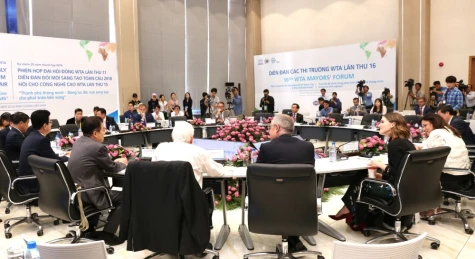
At the scientific conference "The Role of Innovation and STEM education in the Industrial 4.0 hosted by Department of Science and Technology lately, Nguyen Thanh Hai from STEM Educational Research Institute (University of Missouri, USA) said in STEM, there was no longer barriers between learning theoretical knowledge and the application. STEM education programs orients towards practical activities and the use of knowledge to create products or solve problems of real life.

The STEM education model will help learners expand their ability to create, apply, apply scientific knowledge to improve products. In photo: Robotics creativity at "Festival introducing models of creative experiences, technology playground" is hosted by Department of Science and Technology in July.
To Thuy Diem Quyen - a specialist of Microsoft's global education - said that instead of teaching subjects separately and discretely, STEM incorporates them into a cohesive learning model based on practical applications. STEM education does not aim at training students to become mathematicians, scientists, engineers or technicians, but primarily equips students with knowledge and skills to work and develop in the modern world of technology, especially in the trend of Industrial 4.0.
Mai Hung Dung, Member of Provincial Party Standing Committee, Vice Chairman of Provincial People's Committee, said that creative innovation and STEM education were linked to the world’s goal of a creative economy. This is also consistent with the goal of smart city construction and changing the economic growth model of Binh Duong province. In the current stage, STEM will contribute to promoting innovation in education and in the community.
Promoting innovative learning styles
With the benefits of STEM, on 4 May 2017, the Prime Minister issued Directive 16/CT-TTg to assign tasks to ministries to improve the accessibility of Industrial 4.0. Accordingly, the Prime Minister required a dramatic change in policies, contents and methods of education and vocational training in order to create human resources capable of receiving new production technology trends, focus on STEM training in addition to foreign languages and informatics in high school curriculum.
In Binh Duong province, in the growth of Industrial 4.0 and smart city construction, STEM becomes an educational "channel" to build a high-quality workforce.
Mr. Dung affirmed that Binh Duong focuses on science and technology, the quality of human resources as the key pillars of the core model “Triple Helix”. Innovation and science technology are the factors interest provincial leaders. STEM education is an advanced integrated approach that helps bridge the gap between academia and the real world, creating talented people, who work well in a highly creative work environment of the 21st century, of Industrial 4.0.
According to Nguyen Quoc Cuong, Director of Department of Science and Technology, STEM education emphasizes innovative learning style; put learners in the role of an inventor, the learner must know how to expand knowledge, know how to repair and re-processing them to suit the problem situation that learners are dealing with... Therefore, in the coming time, the province will encourage educational institutions, units and localities to focus on STEM education model so as to be able to catch up with the innovation of Industrial 4.0.
STEM stands for Science, Technology, Engineering, and Math. STEM education equips learners with the necessary knowledge and skills related to fields of science, technology, engineering and math, to integrate and complement one another.
Reported by Hoang Pham – Translated by Ngoc Huynh