


Seventy-one years have elapsed, yet the importance and impact of the Dien Bien Phu Victory continue to resonate profoundly, with its historical lessons remaining invaluable. This victory is etched in Vietnam's history as a remarkable milestone, a source of pride, and a wellspring of strength that inspires our entire Party, populace, and military to diligently pursue the objectives of nation-building and defense, igniting the aspiration for a progressively prosperous and joyful country.
Strategic confrontation
In 1953, following eight years of re-invading Indochina, the French colonialists mobilized their economic and military resources, deploying the most advanced weapons and equipment. However, they ultimately failed and incurred significant losses. In May 1953, the French government appointed General Nava—regarded as "a strategist who embodies both literary and martial prowess"—as the Commander-in-Chief of the expeditionary force in Indochina, with the expectation of swiftly securing a decisive military victory and discovering an "honorable exit" from the conflict. In July 1953, Nava introduced a new military strategy for Indochina, known as the Nava plan.
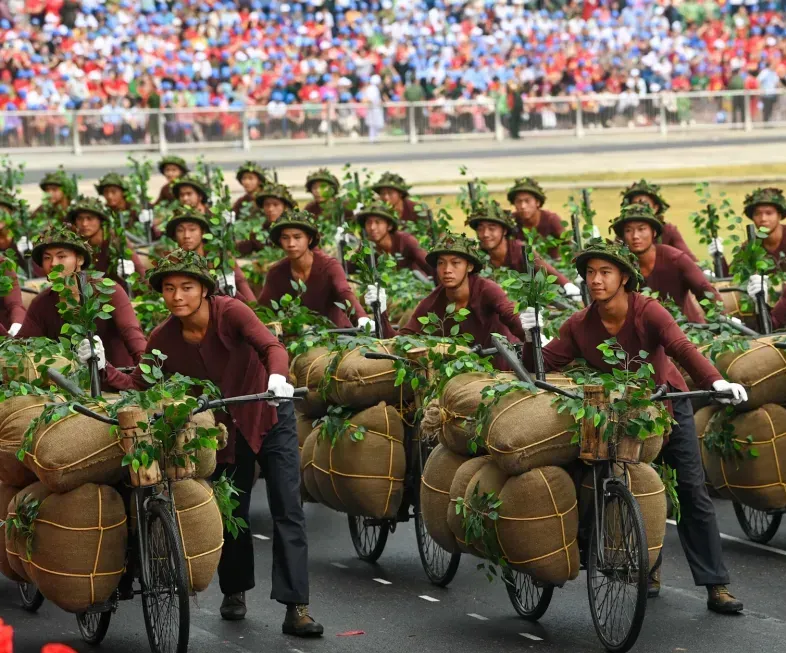
In the photo: The depiction of frontline laborers conveying rice to the battlefield was replicated during the 70th Anniversary of the historic Dien Bien Phu Victory (May 7, 1954 - May 7, 2024).
Confronted with this situation, and after a thorough analysis of the issues, the Politburo and the Party Central Committee (term II) convened at the end of September 1953 to deliberate and propose a strategic policy for the 1953-1954 Winter-Spring military operation. This strategy involved deploying a portion of the main forces to launch attacks on relatively vulnerable enemy positions with numerous weaknesses, while simultaneously capitalizing on opportunities to eliminate the enemy in areas where they could penetrate our liberated zones. The guiding motto and principles for these strategic operations were: to be active, proactive, mobile, and flexible; to engage decisively, advance resolutely, ensure victory, and to refrain from combat if victory was not assured. By implementing the proposed strategic policy, our army and people disrupted the French-American war plan, forcing the French army into a more passive stance in campaign areas such as Lai Chau, Central Laos, Lower Laos, Northern Central Highlands, and Upper Laos, ultimately leading to the initial failure of the Nava Plan.
| After 56 days and nights of “excavating mountains, resting in tunnels, consuming rice balls in the rain,” our forces and citizens fought with valor, intelligence, and ingenuity, ultimately dismantling the Dien Bien Phu stronghold. They annihilated and captured all enemy troops, downed 62 aircraft, seized 64 vehicles, and confiscated all enemy weapons, supplies, and military equipment. The historic Dien Bien Phu campaign stands as a heroic epic of the extraordinary people's war, “recorded in national history as a Bach Dang, a Chi Lang, or a Dong Da in the 20th century, and entered world history as a remarkable achievement in dismantling the stronghold of the colonial slavery system of imperialism.” |
During this period, the Party Central Committee and the Supreme Command were resolute in initiating the Dien Bien Phu Offensive Campaign—a strategically decisive action aimed at conclusively ending the resistance against French colonialism. It was clearly articulated that "This campaign is significant not only from a military perspective but also politically, both domestically and internationally. Therefore, the entire army, the populace, and the Party must focus on its successful completion." General Vo Nguyen Giap was entrusted with the critical role of Commander and Party Secretary for the campaign.
With the slogan "All for the front, all for victory!", the entire nation concentrated on the Dien Bien Phu battlefield. The combat force comprised 55,000 troops, including three infantry divisions (308, 312, 316), Infantry Regiment 57 (Division 304), and Engineer-Artillery Division 351. More than 260,000 laborers and 27,400 tons of rice were mobilized to support the campaign. Tens of thousands of young volunteers collaborated with engineering units to construct roads to the front around the clock, despite enemy bombardments, resulting in the rapid construction and repair of thousands of kilometers of roadways. The preparations across all fronts surpassed expectations, delivering a significant surprise to both France and the United States.
On March 13, 1954, the general offensive commenced, initiating the campaign. After 56 days and nights of combat, surmounting numerous challenges, characterized by "unwavering courage and steadfast will," by the afternoon of May 7, 1954, we had entirely dismantled the Dien Bien Phu stronghold, captured Commander De Castries, and concluded the Dien Bien Phu Campaign triumphantly.
National power intertwined with the vigor of the era
The victory at Dien Bien Phu in 1954 represented a significant milestone in the nation's history, emerging as a symbol of Vietnamese heroism and resilience. This triumph was the result of numerous factors, with the astute leadership of the Party and President Ho Chi Minh being paramount. The fusion of patriotism and the strength of national unity effectively dismantled the military strategies of French colonialism and American intervention, compelling the French government to sign the Geneva Agreement in July 1954, which acknowledged the independence, sovereignty, unity, and territorial integrity of the three Indochinese nations.
The victory at Dien Bien Phu marked a triumphant conclusion to the resistance against French colonialism, instigating significant transformations across various domains, including economics, politics, military, culture, and diplomacy, for the Vietnamese revolution. This success ushered in a new phase: the North progressed towards socialism, while the South persisted in the people's national democratic revolution.
The victory at Dien Bien Phu served to inspire and galvanize oppressed peoples globally to rise and advocate for their independence and freedom. Vietnam stands as a vanguard and a luminous emblem in the struggle for national liberation, dismantling antiquated colonialism, ushering in a new chapter in human history, and contributing to the transformation of the global landscape.
The victory at Dien Bien Phu symbolizes the collective strength of the nation and its era, reflecting the astute leadership of the Party, which serves as a fundamental element in fostering Vietnam's resilience and cultural identity rooted in patriotism. These factors remain pivotal in ensuring the success of the nation's development towards the objectives of a prosperous populace, a robust state, democracy, equity, and civilization.
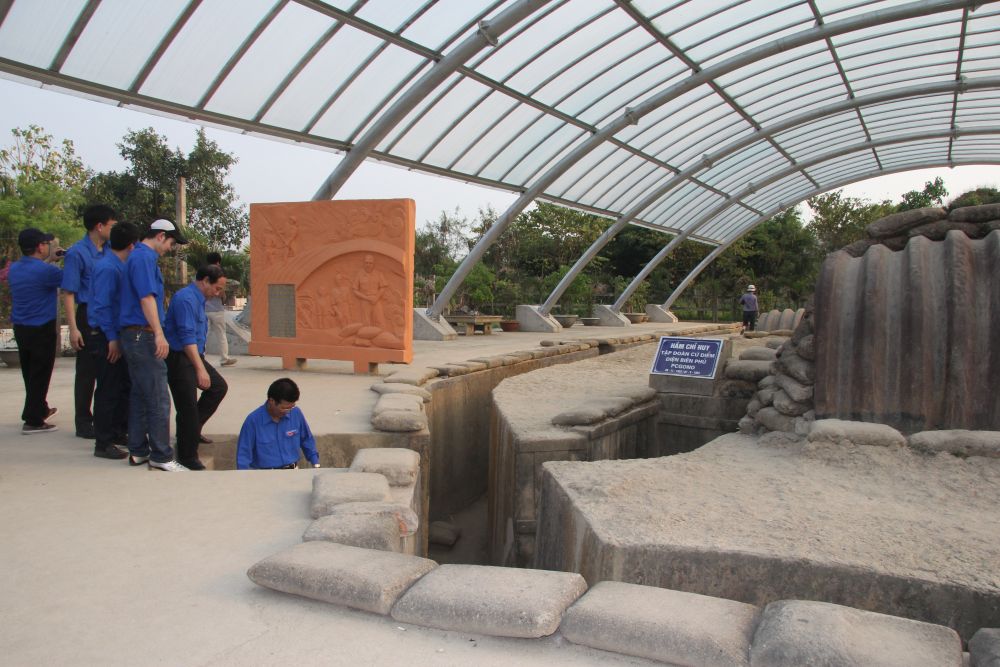
On March 13, 1954, our forces commenced artillery fire to assault Dien Bien Phu. The campaign unfolded in three distinct phases over a span of nearly two months: Phase 1: From March 13 to March 17, 1954, our forces skillfully and valiantly dismantled the Him Lam and Doc Lap strongholds, compelled the Ban Keo stronghold to capitulate, and breached the defensive network in the North and Northeast of the Dien Bien Phu stronghold. This opened the pathway for our troops to advance into the basin and central region. The enemy's two most elite battalions were entirely annihilated, while another battalion and three puppet Thai companies disbanded. A significant quantity of enemy 105mm artillery and 120mm mortars was completely eradicated, and most of the enemy's aircraft in the basin were destroyed by our actions. Phase 2: From March 30 to April 26, 1954, our forces launched simultaneous assaults on the strongholds located in the eastern region of the Central Sub-sector. We eliminated approximately 5,000 adversaries, including 4 battalions and 9 companies, which constituted nearly half of the total enemy forces in the Northern and Central Sub-sector. We secured the majority of the elevated positions in the East, advanced the battlefield near the airport, intensified the siege, partitioned and controlled the remaining territories within the Dien Bien Phu stronghold, secured Muong Thanh airport, and restricted enemy reinforcements to the stronghold. Phase 3: From May 1 to May 7, 1954, our forces seized the remaining bases in the East, dismantled several installations in the West, and initiated a comprehensive assault aimed at obliterating the entire Dien Bien Phu stronghold. At 5:00 p.m. on May 6, 1954, our artillery and rockets unleashed a relentless barrage on enemy positions, paving the way for infantry advances. At Hill A1, after detonating one ton of explosives to neutralize the enemy's underground bunker, our troops split into multiple units, navigating the trenches to assault the summit of the hill. At 5:30 p.m. on May 7, 1954, General De Castries and the entire General Staff of the Dien Bien Phu stronghold were captured alive. That same night, our forces pressed the attack on the Southern sub-sector, compelling the enemy to retreat to Upper Laos. By 10:00 p.m., all enemy personnel had been taken prisoner. |
By Dam Thanh – Translated by Vi Bao