


On 25 Oct, Department of Natural Resources and Environment held a conference to launch the movement "Say no to plastic waste". In order to change businesses and people’s awareness of the risk of plastic waste, the department has carried out many programs, in which the propagation and dissemination about the risk of plastic waste received much attention. On this occasion, Binh Duong Newspaper had an interview with Nguyen Hong Nguyen, Deputy Director of Department of Natural Resources and Environment.
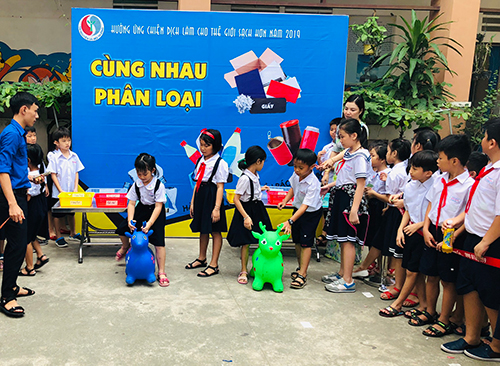
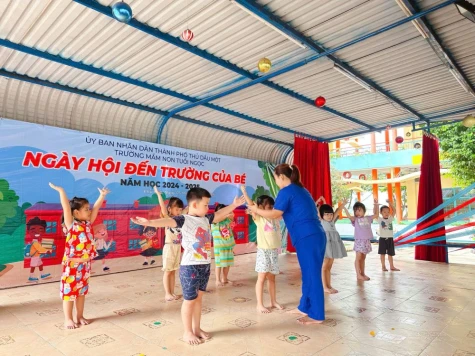
The movement "Say no to plastic waste" is held at Hiep Thanh Primary School (Thu Dau Mot City).
- Could you tell us what is the harmful impact of plastic waste on the environment?
- Every year, Vietnam discharges into the sea 0.5 million tons of plastic waste. Currently, Vietnam is the fourth largest country in the world in terms of plastic waste discharged into the sea, after China, Indonesia and the Philippines. Plastic waste does harm to the environment is no longer a threat but a reality in the immediate future, causing the adverse effect on people.
The most dangerous harm of nylon bags is that it is very difficult to decompose, may exist for hundreds of years in the natural environment, causing environmental pollution, threatening ecosystems. Once released into the ocean, it takes more than 400 years for plastic waste to be fully decomposed.
According to statistics, more than 1,000 nylon bags are consumed every minute in Vietnam, only a small portion of the aforementioned plastic waste is collected, recycled, and the remaining is buried with garbage or disposed of everywhere, in which the sea is one of the final destinations of nylon bags. Therefore, limiting the use of nylon and minimizing disposable plastic items is an urgent measure to protect the environment and future generations.
- Could you explain why people know the harmful effects of plastic waste on the environment but still use it?
- In fact, most people know the use of nylon bags is harmful to the environment but they still use and this use is increasing due to the convenience and durability of this material. On the other hand, due to the development of science - technology, the production of nylon bags is very simple and the price is very cheap, so people still use.
- In Binh Duong, how is plastic waste collection and treatment carried out, sir?
- With the current characteristics of industrial development, Binh Duong province has a fast mechanical population growth rate. This is the main cause of pressure on the increase of domestic waste in the province, leading to an increase in plastic and nylon waste (the proportion of plastic and nylon waste in domestic waste accounts for about 10%). With the total volume about 1,800 tons / day of domestic solid waste, an average of 180 tons of plastic and nylon waste is generated in the province every day. Therefore, putting great pressure on the collection, classification and disposal of this particular type of waste.
Currently, all domestic waste, including nylon waste, is collected and treated at South Binh Duong solid waste treatment complex of Binh Duong Water - Environment Joint Stock Company, in which collection for recycled plastic products is about 20-30% (30-50 tons), the remaining is mostly burned in a specialized 2-stage incinerator, partly buried hygienically.
- In order for the movement of reducing plastic waste to be highly effective, in the coming time, what is the action plan of DONRE?
- Department of Natural Resources and Environment recommended Provincial People's Committee to issue a plan for the movement against plastic waste (in Plan No. 4950/KH-UBND dated 1 Oct 2019). Accordingly, Provincial People's Committee launched the movement to "Fight against plastic waste" in the whole province. Specifically, the province focuses on raising the awareness and responsibility of all levels, sectors, organizations and individuals about the impact of environmental pollution, due to the use of disposable plastic items and persistent nylon bags in order to change from awareness to specific actions to gradually reduce the use of disposable plastic items and persistent nylon bags, replaced by environmentally friendly, reusable products.
In particular, the province focuses on three main contents: Communication, raising awareness of the community; minimize the production of plastic waste and persistent nylon bags in production and daily life; strengthen the implementation of specific solutions in waste management and treatment, focusing on plastic waste. Provincial People's Committee instructed provincial agencies to immediately not use single-use drinking water bottles, thereby significantly reducing the number of daily bottles generated in activities of State agencies in the province.
Reported by Phung Hieu – Translated by Ngoc Huynh