


The year 2018 continued to be a successful year for Binh Duong textile and garment enterprises with a 16% increase in sales compared to 2017. Currently, garment enterprises in Binh Duong are looking for ways to increase labor productivity, improve management capacity, investment in digital technology to improve production capacity, take advantage of opportunities from the market.
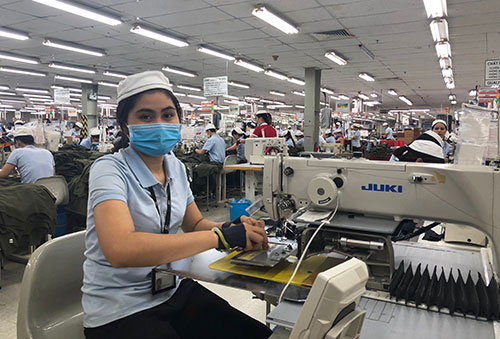
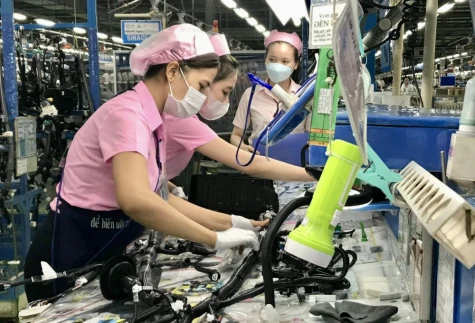
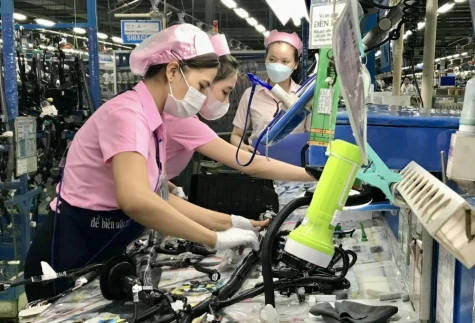
Production line at Vietnam Esquel Garment Manufacturing Co., Ltd (Thuan An Town).
Many advantages
According to provincial Department of Industry and Trade, in 2018, textile and garment export turnover of the province was estimated at $2,649.8 million, an increase of 16.8% over 2017. In 2018, China-US trade war occurred. It is a great opportunity for Vietnam's garment industry, as the wave of investments and export orders are tending to shift from China to Vietnam, especially from major export markets such as the US and Japan, Korea, China, and Europe. In addition, the participation in trade agreements in recent years has been motivating the textile and garment enterprises to invest in the development of domestic raw materials in order to increase the localization rate, meeting the requirements for goods origin to be eligible for preferential tariff.
In fact, many textile and garment enterprises in the province have completed orders signed in 2018. "The business of textile and garment enterprises in the province in 2018 is very dynamic. Most companies completed signed orders and signed new orders for the next year. This is a good signal, showing that enterprises have seized opportunities and adapted well to fluctuations of the market economy. At this time, many enterprises have signed orders for 6 months, even for the year 2019”, said Le Hong Phoa, Chairman of Binh Duong Textiles Association.
According to Mr. Phoa, from the beginning of the year, key export markets of the province such as the United States, European Union, have continued to achieve high growth rate over the same period last year. Notably, the number of importers from the US, South Korea ... shifting their orders to Vietnam has increased sharply recently. With favorable markets, many textile and garment enterprises in the province nearly completed production and business plan in 2018.
In recent years, big brands in the world have invested in Vietnam to enjoy preferential tariffs that Vietnam is eligible for according to trade agreements. Vietnamese enterprises are also more and more attractive to customers thanks to the competitiveness and the potential to complete the supply chain.
To make a big investment in technology
Experts said that the export of textile and garment enterprises in 2019 would continue to grow strongly. To Binh Duong province, in 2019, the textile and garment industry would continue to grow strongly. For simple labor-intensive industries such as textiles and apparel, the adoption of industry 4.0 would be very important with many new opportunities.
In the face of rising competition in the market, Binh Duong textile and garment enterprises have been looking for ways to increase labor productivity, improve the management capacity, invest in digital technology to reduce labor-intensive. Mr. Phoa said that many textile and garment enterprises in Binh Duong invested in digital machinery to improve management capacity; shifted from outsourcers to manufacturers... with the desire to bring higher value in the supply chain.
Although garment enterprises now have many advantages with abundant orders, experts warned about the challenges facing textile and garment industry in the global supply chain. First of all, garment enterprises have difficulties in human resources. In fact, despite the high level of workmanship, according to garment enterprises in the province, labor cost increased, leading to many derived expenses, making a large burden of labor cost to enterprises. In addition, raw materials, which are imported from other countries, must pay additional taxes if the garment from that country originates from China; then Vietnamese garment will be subject to strict examination.
However, according to Mr. Phoa, the good news is that textile and garment enterprises in Binh Duong have boldly switched to using materials from domestic sources and other countries, instead of mainly relying on Chinese sources.
Reported by Tieu My – Translated by Ngoc Huynh