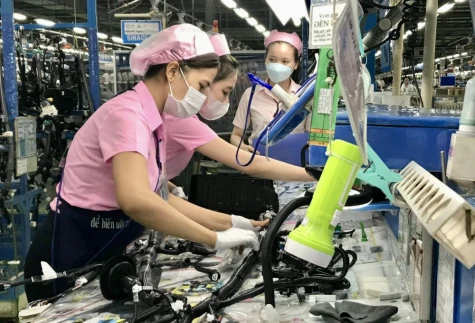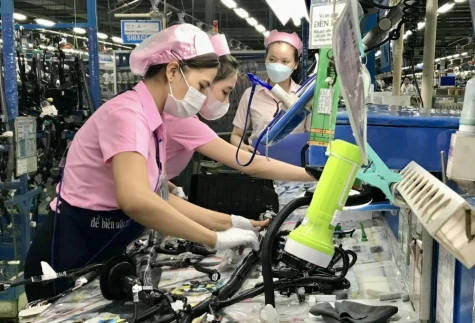



Due to the complicated, unpredictable development of Covid-19, most manufacturing and export enterprises face difficulties, such as lack of raw materials for production, export orders are interrupted, delayed payment of goods. However, they strive to maintain production and encourage workers to strictly implement the epidemic prevention, health improvement.
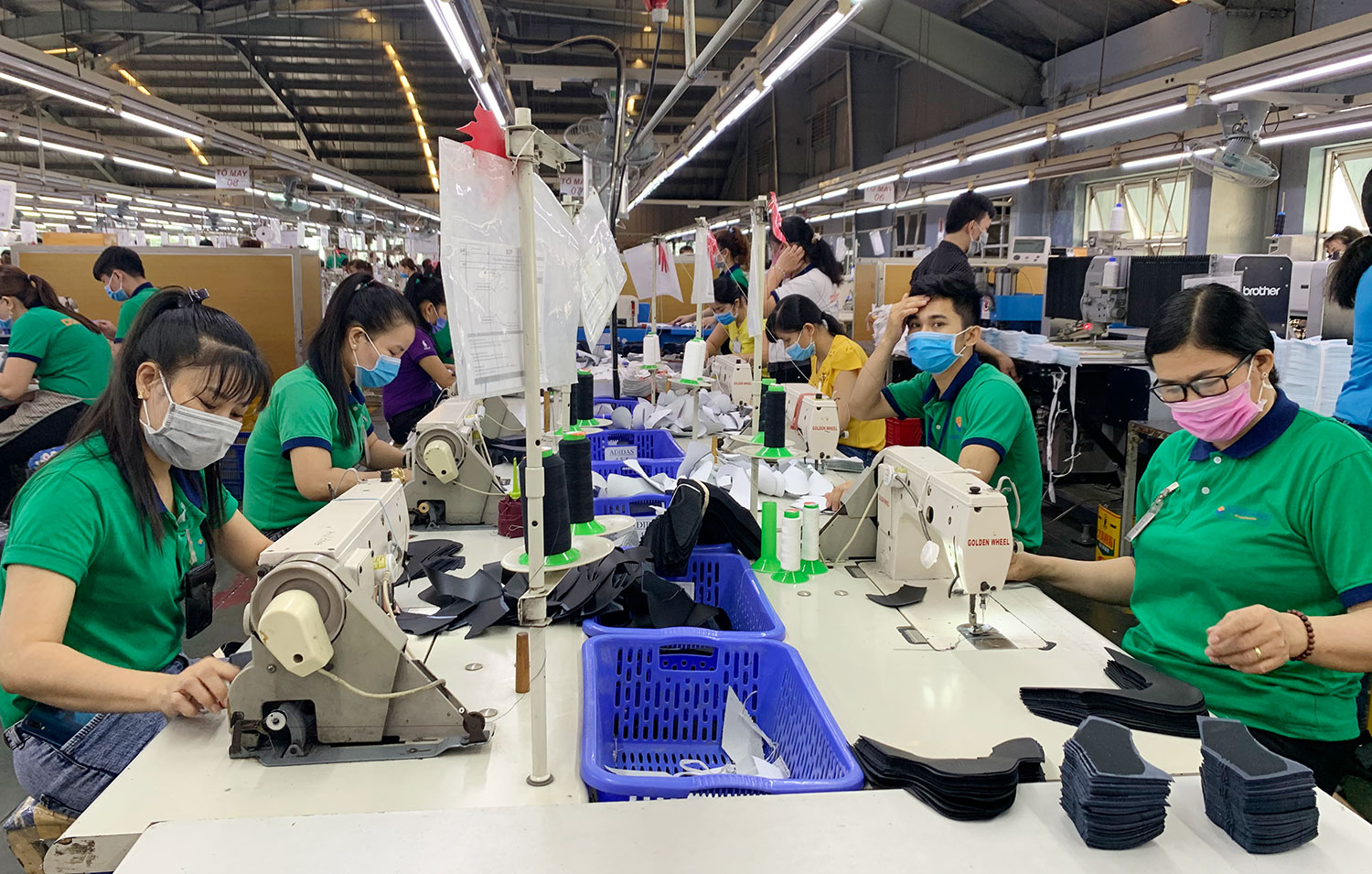
Textile enterprises in the province strive to maintain production activities.
Efforts made amid the pandemic
According to Dien Quang Hiep, Chairman of Binh Duong Furniture Association (BIFA), the production and export of timber industry face more and more difficulties, however many companies still strive to maintain production by cutting 30-50% of production scale, reducing to 4 working days per week to secure the employment and income of workers. According to companies, payment of previous exported orders have been delayed causing financial difficulties. On the other hand, enterprises are struggling to find export orders for Q2-2020, because consumption of their conventional markets dropped sharply.
It is predicted that if the epidemic does not shrink, by the end of April 2020, there will be 30% enterprises to cease production, and up to May, will be 50-60% enterprises to cease production. Currently, the available raw material source is still sufficient for timber enterprises to maintain production up to May 2020. Many enterprises in BIFA strive to seek domestic raw materials to replace the imported raw materials, while implementing a variety of solutions to ensure workers' safety in this epidemic period.
Regarding textile industry, a good news is when the Chinese market has had positive transformation, some companies supplying raw materials in China have begun to work again. However, enterprises in textile and footwear industry also had difficulties in exporting previously signed orders and signing new export orders in conventional markets: USA, South Korea, Japan, Europe. The negotiation of a new order is also struggling because the retail selling in major markets has declined. To resolve this adverse situation, some companies are shifting to the domestic market. At the same time, many companies switched to cloth mask production to serve domestic demand and export.
According to provincial Ceramics Association, main raw material source for domestic production, some auxiliary materials, such as chemical, enamel, colors imported from China but the quantity is not significant. Companies are flexible as using other sources. Due to the decline of domestic consumption and export, slow payment from customers and increasing inventory, many enterprises do not have enough reinvesting capital, have to work perfunctorily.
According to Tran Thanh Trong, Chairman of provincial Electromechanical Association, companies in the association are still working every day to maintain production, overcome the difficulty, waiting for the epidemic to end. Enterprises in the association, depending on business type, face various levels of difficulty. Enterprises of precision mechanical manufacturing and processing employing advanced technologies have raw material sources mainly imported from Europe, Japan, and South Korea... Even though they have fixed production contracts, the export is also in a sluggish situation due to the pandemic.
Regarding businesses manufacturing mechanical products to serve people's needs (generators, electric fans, lighting equipment...), 20-50% of their raw materials is imported from China , some enterprises must import up to 80% materials, thus the recovery of Chinese market is a very good signal. In addition, these sources of raw materials are imported from provinces outside the epidemic centers, hence they sustain the contact and supply. On the other hand, enterprises had a good preparation from the fourth quarter of 2019, thus production activities are still maintained until May 2020.
Meanwhile, businesses producing electrical home appliances and refrigeration mostly use materials imported from China (from 70 - 80%), South Korea, and Japan. In addition, because the electronic industry usually imports a certain amount of enough raw materials to produce for each contract (for each specific product such as air conditioner, TV screen, Led screen...), thus manufacturers do not stock up much materials. Currently, enterprises are also in a slack period.
To proactively support businesses
Tran Thanh Liem, Chairman of Provincial People's Committee, asserted that in the second quarter of 2020, Binh Duong would continue to implement measures to prevent and control Covid-19. All governmental levels and sectors take the initiative in ascertain the production situation, business and labor of enterprises to have timely support solutions; especially, monitor the labor situation at enterprises, set up alternative labor sources in case of labor shortage, foreign experts.
According to provincial Department of Industry and Trade, the Ministry of Finance made a suggestion to the Government to delay and defer payment of taxes and land rents to remove difficulties of businesses affected by the Covid-19. However, beneficiaries of this support will not include ceramic, consumer goods manufacturing and agricultural product processing industries. The Department advised Provincial People's Committee to make proposal the Government and Ministry of Finance to add the aforementioned industries to beneficiaries' list, because these manufacturing industries in Binh Duong are seriously affected by the Covid-19.
The province also asked the Government and the State Bank to instruct credit institutions and commercial banks to enhance the public and detailed guidance so that businesses are able to access support policies, such as rescheduling debts, exemption, reduction of interest rates, fees to support customers affected by the Covid-19. In order to ensure raw materials for production of medical supplies, the province also asked the Government to direct Ministry of Foreign Affairs to work with Chinese enterprises to support the supply of these raw materials.
Salary payment for workers is also a big difficulty. Therefore, the province also proposed the Government and Ministry of Labor - Invalids and Social Affairs to issue specific guidance on the responsibility of employers and employees directly affected by the epidemic. This is one of the policies aimed at ensuring social security, supporting businesses to restructure human resources, retain employment for workers in the stagnant production and business situation.
Reported by Tieu My - Translated by Ngoc Huynh