


Along with the opportunities from the free trade agreements that Vietnam has participated in, bringing in, in 2019 the domestic textile and clothing industry is evaluated by economic experts to continue to have many advantages. In fact, many enterprises operating in the textile and garment industry in the province have signed orders until May 5, 2019.
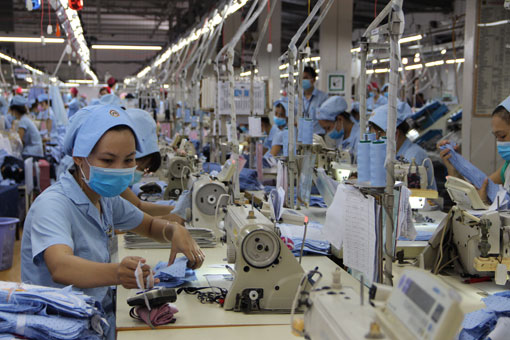
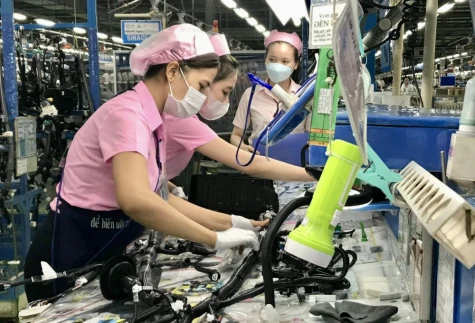
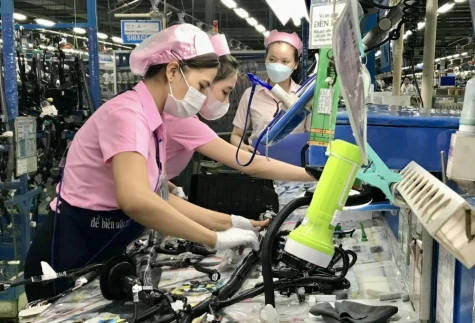
Production line of 3-2 Garment Company. Photo: Phuong Le
Abundant orders
In 2018, the province's textile and garment exports focused mainly on key markets such as the US, European Union, Korea and China. Along with that, in 2018, when the Sino-US trade war took place, it was considered a great opportunity for Vietnam's textile and apparel industry, when the wave of investment in export orders tended to shift gradually. from China to Vietnam.
The country's participation in trade agreements in recent years has been creating motivation for domestic textile and garment enterprises to invest in developing and increasing the localization rate to meet the requirements of origin of goods. to get preferential tariffs. For Binh Duong, the export footwear industry always maintains a high growth rate, currently a high proportion of the province's total export turnover.
In 2018, the implementation of activities to implement free trade agreements that Vietnam has participated in, including the Vietnam - EU Free Trade Agreement (EVFTA), the Full Partnership Agreement and Trans-Pacific Progress (CPTPP), has created a strong development opportunity for Vietnam's leather footwear export industry. The results achieved in 2018, together with favorable conditions, will be the foundation for enterprises producing and exporting textile and footwear industries in the province to continue to have many applications. goods in 2019.
Phan Le Diem Trang, Vice Chairman of Binh Duong Garment Association, Director of International Garment Company (An Dien Commune, Ben Cat Town), said that in 2018 the company changed its operating model from processing. to produce. Since transforming this production model, the company has been more proactive with customers; The company's export revenue also increased, the number of orders increased, exports also increased compared to 2017. At this time, the company has signed orders until the end of May 2016. And Ms. Truong Thuy Lien, Director of Lien Phat Company Limited (TX An An), said in 2018, the company's export increased by about 10% compared to the previous year. The company's orders in 2019 are expected to increase by 5-7% compared to 2018.
Making good use of opportunities from CPTPP
On December 30, 2016, CPTPP started to take effect. According to experts, when the CPTPP takes effect, it will create a big boost and bring development motivation for Vietnam's export industries, especially the textile and footwear industries. One of the important contents of CPTPP is the elimination of 95-98% of tariff lines as soon as the official agreement comes into effect, the remaining tariff lines will be cut down according to the 5 - 7 year schedule. This is considered a positive factor to the development and export turnover of domestic textile and footwear.
According to the Vietnam Textile and Apparel Association, CPTPP will help Vietnam boost growth as well as change the export market structure towards a more balanced way, when the tax rate is equal to 0%, helping Vietnam textile and garment industry expand its market. In some countries with high tax rates such as Canada, New Zealand, Australia ... As well as textile and garment, CPTPP is an opportunity for leather and shoe exporters to increase their proportion, increase export opportunities to potential markets. Vietnam has no trade agreement such as Mexico, Canada, Peru ... Japan alone - one of the key markets of Vietnam's export of footwear and bags with an average growth rate of 20 - 35% a year. If businesses know how to make full use of terms from CPTPP, this growth will be higher than the current increase.
However, CPTPP has a strict requirement of origin principle. This is a big challenge for Vietnamese enterprises in general and the textile and footwear industry in particular, because the supporting industry of textiles and footwear is heavily dependent on imported materials from China, India and some ASEAN countries.
According to Phan Le Diem Trang, with the free trade agreements that Vietnam has been taking effect, in 2019 promises many orders for businesses, can increase from 5-8% compared to with the previous year. However, although CPTPP is expected for the domestic textile industry to develop, businesses still have to rely heavily on imported materials from China. This is a big difficulty for domestic textile enterprises.
Reported by Phuong Le – Translated by Vi Bao