


In recent years, provincial Department of Industry and Trade has actively collaborated with other departments, sectors, and localities to carry out many activities of communication, seminars, trainings on cleaner production to raise state management agencies’ awareness and for business support.
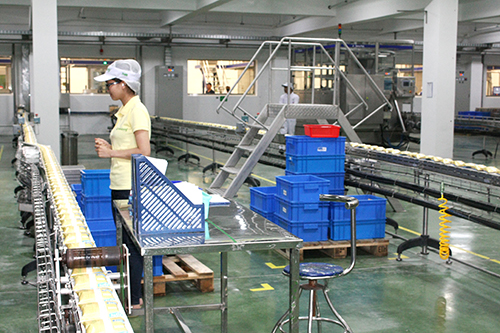
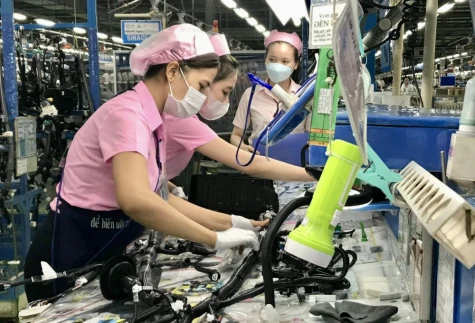
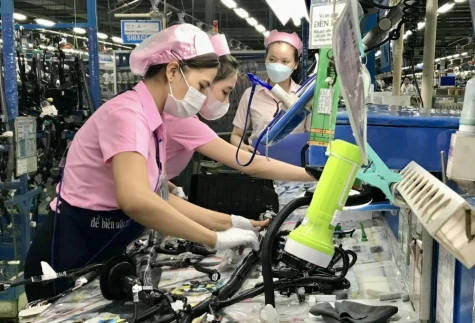
A production line at Vinasoy Soy Milk Company.
Modern industrial strategies
Experts assessed that, along with the international integration trend, cleaner production had become one of the important strategies of modern industrial production. Cleaner production not only helps businesses improve production efficiency, reuse waste products and semi-finished products, create a better image for businesses, but also help protect workplace environment, improve employee’s health, and facilitate sustainable industrial growth.
Cleaner production in industry is the activity of improving the efficiency of using raw materials, fuels, and energies, reducing the consumption of raw materials and energies for one production unit, eliminating the maximum of toxic materials, and reducing toxicity of waste streams and waste before they are removed from the production process. Cleaner production reduces negative impacts on the environment throughout the life cycle of products, from raw material extraction to final disposal through proper product design, cleaner production will reduce the level of waste generation, consumption of raw materials, energy and water, and save production costs for businesses.
Cleaner production projects are able to increase the productivity and efficiency of enterprises, improve working conditions, and limit the increase in pollution caused by industrial production; thereby reducing waste generation, making the environment constantly improved, and reducing the cost of environmental treatment. The application of cleaner production into production will also increase competitive advantage, lower production costs, improve product competitiveness of businesses in the market.
In order to help industrial enterprises access to cleaner production technology, Department of Industry and Trade organized a training course to improve cleaner production assessment capacity. The training course focused on propagating, disseminating, and guiding the approach of cleaner production methods, on that basis, businesses and production facilities assessed and proposed specific solutions to accelerate the application of cleaner production.
In addition, Department of Industry and Trade supported 35 enterprises and rural industrial production facilities in advanced machines and equipment for production, with the total support of over VND 862 million funded by the national and local industrial promotion budget. The support helped businesses turn towards environmental protection, including production control, thorough savings of input materials, reuse of waste products, and investment in waste treatment systems. This is a regular task in industrial promotion.
In 2016, Department of Industry and Trade advised Provincial People's Committee to issue Decision 1849/2016/QD-UBND on provincial industrial production plan for the period 2016-2020, with the goal of spreading widely the cleaner production approach among industrial production facilities to improve the efficiency of using raw materials and fuels, minimize emissions, and limit the increase of environmental pollution, as well as ensure working conditions for workers and residents of the community.
Enterprises need to raise awareness
According to Center for Investment, Trade and Industrial Development Promotion (under Department of Industry and Trade), currently the application of cleaner production in the province has some difficulties, due to low enterprises’ awareness of benefits of cleaner production. Many businesses believe that cleaner production is merely related to environmental sanitation. Therefore, business leaders almost don't care, even think that cleaner production may cause additional costs for businesses.
Besides, many businesses are afraid of changes, because they think that they still operate well without any other intervention. Technical barriers are also an important reason that cleaner production has not really come into production and business of enterprises. Currently, the majority of enterprises in the province are small and medium sized, production technology is limited, especially financial capacity is not strong enough, so investment in new technology for cleaner production faces many difficulties.
Furthermore, businesses often tend to focus on sales rather than investing in new technologies and machinery to reduce production costs. Moreover, to SMEs, the investment costs for advanced technologies, saving raw materials and fuels are often large compared to the capabilities of enterprises. Therefore, it is difficult for businesses to apply new technological solutions. Therefore, cleaner production is still considered only as a project, not a continuous implementation strategy of enterprises.
Representatives of Center for Investment Promotion, Trade and Industrial Development said that to promote the cleaner production process, the State needed to have solutions and preferential policies to offer financial support to enterprises investing in technology and machinery, because businesses in the province are mainly SMEs. In addition, the authorities need to intensify reviewing and assessing the current technology status of each enterprise; strictly punish enterprises and production facilities that cause environmental pollution. Especially in the process of granting new investment licenses, state management agencies need to perform well the inspection and evaluation of technological lines, avoiding the situation of importing old machinery, outdated technologies causing financial waste and bad environmental impacts.
Currently, the expansion of cleaner production in industrial production and craft industry is an objective requirement of the national economic development process. However, with low scientific and technological level of enterprises in the province, the implementation of cleaner production must attach importance to historical factors.
Based on the survey and assessment of business current situation, state management agencies need to build a specific implementation roadmap in each period, for each field, and encourage enterprises to formulate their own plans and roadmaps to invest in technological innovation and machinery. In this way, the cleaner production program can be implemented synchronously, efficiently, meeting the requirements set out in the current economic development process.
According to industry and trade sector, businesses and production facilities in the province have been aware of environmental protection. But due to limited financial, technological, and technical capabilities, many enterprises have not implemented cleaner production in manufacturing. In addition, the state management and assistance and orientation for businesses and production facilities in cleaner production in the province have just stopped at evaluation of basic designs...
Reported by My Phan – Translated by Ngoc Huynh