


Along with strongly developing the local agricultural sector with rubber seen as a kind of key tree, Dau Tieng has determined to promote trade-services towards faster and more stable economic growth.
Forces increased
As of June 2015, the whole district had a total of around 50,900 hectares of rubber, a year-on-year increase of 0.29%. In recent years, the district’s total growing area for this kind of tree has still been maintained, despite latex rubber prices plummeting. The district has also seen an increase in the growing area for other plants, in which there are 504 hectares for rice cultivation.
.jpg)
Dau Tieng district has promoted infrastructure development to create breakthroughs on socio-economic development. In picture: A rural road in Dau Tieng township looks very spacious.
The district is now also home to 184 animal husbandry farms, including 64 ones meeting criteria of the Ministry’s Agriculture and Rural Development’s Circular No.27/2011/TT-BNNPTNT dated April 13, 2011. According to statistics, the district has a total of more than 5,100 cows, buffaloes; more than 1.53 million pigs and 116,000 square meters for aquaculture. There are also 43 households getting involved in breeding more than 4,500 wild animals.
In addition, the district has made efforts in developing the local rural traffic system. The district has so far worked out 57 works and 159 roads with a total length of more than 198 km. There have also been more than 97% and 86% of main roads and rural or in-field ones covered by asphalt and gravel, respectively…
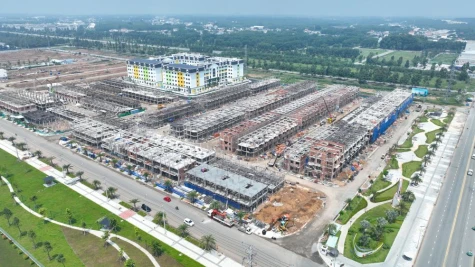
Image of a rural new area formed up
Thanks to the complete leadership, instruction of authorities at all levels plus people’s high consensus, Dau Tieng district has gained considerable achievements in socio-economic development. The district’s total production value since early this year has been estimated at more than VND1.15trillion. Of these, VND265bln came from agricultural production; VND406 from industrial manufacture and VND482bln from trade-services.
One of Dau Tieng district’s considerable successes over the past time was the movement of “Mobilizing all people to build up rural new areas”. The district now has a total of 7 communes selected for new rural construction. In 2013 and 2014, there were 4 communes of Thanh An, Long Tan, Dinh Thanh and Dinh Hiep recognized as new rural ones. They have continued enhancing the quality of criteria on new rural construction, thereby greatly contributing to improving people’s lives.
The district is still upholding its advantages together with experience to further develop the new rural construction movement, contributing to promoting the local socio-economic development and increasing income for people from all strata. So far, Minh Hoa, Thanh Tuyen, Long Hoa, Dinh An, An Lap communes have reached 17 or 18 criteria of the new rural construction program and are urgently fulfilling the remaining criteria to be recognized as new rural ones in 2015.
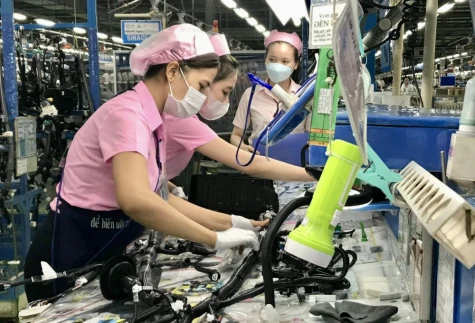
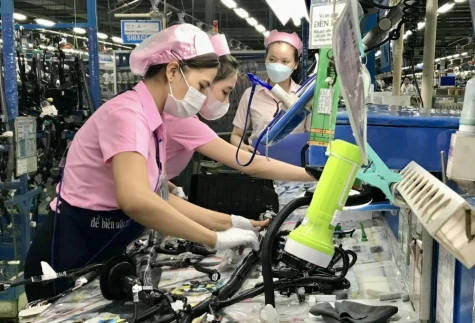
Also thanks to the attention of authorities at all levels together with the efforts by people from all strata, Dau Tieng district has reached a rapid shift on economic structure towards the growth of industrial manufacture and trade-services. When being established in 2000, the district had an economic structure with 78.11% in agriculture, 1.25% in industry and 20.63% in trade-service. Till now, the district’s economic structure has been shifted with proportions of 35.98% in agriculture, 30.69% in industry and 33.33% in trade-service. This will be the foundation for the district to further speed up trade-service development, contributing to promoting the local socio-economic development and taking care of people’s lives.
According to Nguyen Phuong Linh, Vice-Chairman of Dau Tieng district’s People’s Committee, the district will further promote construction of infrastructure facilities, especially rural traffic works at the local development requirements. The district will also speed up the implementation of the rural new construction program to be able to soon fulfill the set targets in the domain.
Reported by Khanh Vinh-Translated by K.T