


Despite Government efforts, domestic auto production has not yet satisfied demand. Pham Anh Tuan, Deputy Director of the Department of Heavy Industry, talks about domestic automaking prospects.
The Government has defined the automobile industry as a key sector because it will pervade other industries such as mechanics, electronics, metallurgy and chemicals, paving the way for Vietnamese businesses to join in the global production chain.
In the Government's automobile industry development strategy by 2025 with a vision to 2035, and the Vietnam automobile industry development plan by 2020 with a vision to 2030 issued in 2014, the Government has presented many policies to support and strengthen the market's supply and demand.
We will focus on developing small sedans with nine-seats or less, which are not only suitable for Vietnamese people and their budgets, but also matches the world's trend towards smaller cars that consume less energy and are more environmentally friendly.
As for trucks and passenger cars, we will develop locally manufactured vehicles that are advantageous to the Vietnamese market, vehicles used in agriculture and specialised-use vehicles such as small trucks for rural areas, concrete mixers, tankers, agricultural multi-function vehicles and vehicles for security and national defence.
In the coming time, the Government's orientation is to strengthen cooperation among domestic businesses and big foreign enterprises in manufacturing components and parts. In particular, we will focus on important parts such as engines, gearboxes and transmissions to meet the domestic market's demand. We expect to replace imported parts and in the future start to export these parts.
* Do businesses actively join in local production and assembly?
Yes, they do.
In the market, you can see the active and deep participation of businesses from various economic sectors including domestic companies such as carmaker Truong Hai Automobile JSC (Thaco) and giant automakers such as Toyota, Ford, Honda and Mitsubishi. The total auto production and assembly output is about 460,000 units per year, embracing most types of small sedans with a capacity of 200,000 units, and trucks and passengers cars with a volume of 215,000 units.
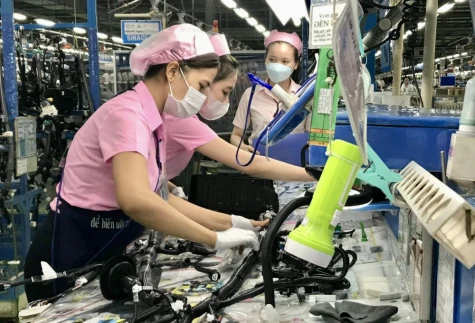
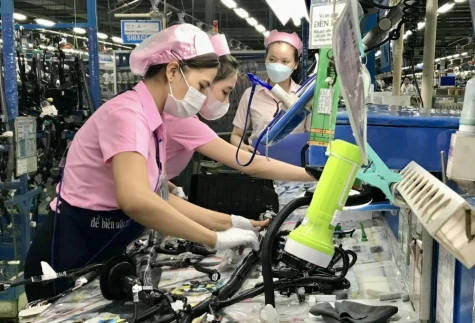
I think businesses have initially formed a local supply industry, providing the market with a number of parts for local automakers. They have significantly contributed to the State's budget with an annual average of 1 billion USD (taxes only) and created direct jobs for about 80,000 workers.
We have accumulated experience in assembling autos and producing a number of components and parts. The parts supply industry has been formed; however, few businesses have invested in production lines of auto bodies.
We have not yet created close cooperation among automakers, assemblers and parts suppliers. We have also not formed a system of large-sized material suppliers, and components and parts producers.
We have not reached the target of having cars at reasonable prices, which are suitable for the Vietnamese people's pocket. Prices are still high compared with other countries in the region.
* What is the average local parts supply rate in the Vietnamese auto industry? What car parts does Vietnam produce itself?
We have reached an average rate of 7 to 10% for the local parts supply rate in cars with nine-seats or less. Local automaker Thaco is made from 15 to 20 percent local parts, while Toyota Motor Vietnam has reached 37 percent for its Inova model.
For trucks and passenger cars with 10 seats and above, and locally manufactured specialised-use vehicles, we have attained a high rate of local parts supply.
With an average local parts supply rate of 55 percent, locally manufactured trucks have met 70% of the market's demand. Meanwhile, special-use vehicles have 45-55% of local parts supply and meet 90% of the market's demand.
We need to acknowledge that the rate of local parts supply is quite low. According to the Government's strategy and plan, the average rate should be 40% by 2020 and 45% by 2025.
Vietnam has produced a number of parts such as mirrors, glass, seats, electrical wiring products, batteries, tyres, tubes and plastic products.
* Will Vietnamese automakers have to deal with fierce competition from ASEAN members in 2018 when the import tax becomes zero for vehicles with 40% local parts supply?
Yes, but not too much.In the market, there will always be one product to replace another product so the competition will not be as fierce as we thought. Big automakers in ASEAN, mainly Japan, usually have policies to divide the market clearly, not crossing into other areas. For example, Vietnam has mainly imported pick-ups because this kind of vehicle is not made in the country.
* What is the position for foreign businesses who want to invest in parts supply in Vietnam?
We have joined various international commitments so that we do not classify businesses as domestic or foreign. Therefore, any preferential policies we implement will apply to both domestic and foreign businesses.
We always encourage foreign businesses to invest in the parts supply industry in Vietnam, especially those in Tier-one (who are direct suppliers) who can support domestic businesses to raise capacity, then regularly help them to become Tier-one suppliers themselves. We expect to form Tier-one Vietnamese suppliers to supply auto parts for global groups.