


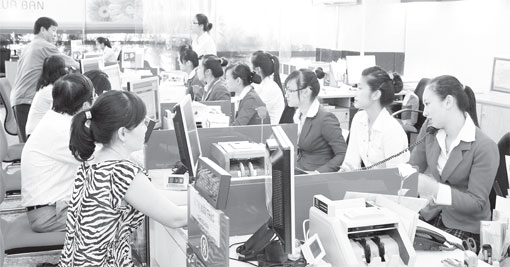
Clients at HDBank’s Binh Duong branch.
Part 3: Solving difficulties for financial sector
Since the end of 2011, financial sector has prepared ways for integration. However, how to minimize negative impacts and improve competitive capacity and operational efficiency of financial sector? This issue has been much concerned by the sector leaders.
Many achievements gained
After 8 years of WTO admission, Vietnamese economy has been under strong development in many fields, including banking. According to the State Bank’s Binh Duong branch, the number of newly-established banks has since 2008 soared rapidly compared with the 5 previous years. Until now, the entire province has had 64 credit branches and credit organizations. These units have been under stable operation and created diversification of possession form.
Despite difficulties of economy, rate of bad debt of local banks is still under control. Aside from birth of banks, system of transaction has spurred rotation of capital. Besides, since early 20014, our country ended negotiations of trade and economic agreements including the Free Trade Agreement with the EU, Korea, Russia-Belarus-Kazakhstan as well as TPP, establishment of ASEAN Economic Community (AEC) and more. Once integration, Vietnamese banks will enjoy opportunities to develop in foreign nations. Conversely, big foreign banks such as HSBC, ANZ, Citibank, HongLeong and more will enjoy opportunities to invest in Vietnamese market.
Door opened
According to Tran Ngoc Linh, director of BIDV Binh Duong, the biggest challenge lies in competitive pressure while most of local banks face many shortcomings and restrictions in capacity, finance, knowledge, management experience and more. Therefore, banks must perfect further their capacity to compete in the integration period.
Linh added that domestic banks should maintain proper structure of organization as well as accelerate risk of banking administration, develop IT network, train and improve knowledge for banking staff. Moreover, Vietnamese enterprises and banks need to obey international regulations and standards.
Meanwhile, Nguyen Thai Minh Quang, director of Vietcombank’s North Binh Duong branch assessed that most of banks have much capital for loans but enterprises moan about obstacles of approaching loans. The most basic thing is that banks have yet to prove feasibility of capital lending projects.
Adapting for integration
Deprived from importance of integration, restructure of bank is one among three key problems of economic restructure that has been launched since the end of 2011. After 3 years of implementation, important goals of restructure of credit organization system have reached initial results. Initially, purpose of the State bank is to cut bad debt rate under 3% in this year, according to the Government Prime Minister.
The State Bank governor Nguyen Van Binh asked banks to focus on solving bad debts, control and improve quality of credit organization, contributing to solve difficulties of production and business and gain a proper growth.
Nguyen Phu Cuong, vice director of the State Bank’s Binh Duong branch said that the State Bank has thus far continued to steer credit organizations to solve bad debts. In the coming time, the State Bank will continue to hasten progress of solving bad debts in attachment to restructure of credit organizations.
Firstly, the State Bank will concentrate on perfecting legal framework, facilitating bad debts’ settlement as well as ask banks to publicize bad debts and announce results of implementing measures of control of credit quality.
Cuong added that 2015 belongs to roadmap of carrying out project of restructuring system of credit organizations. Obviously, entering integration, banks realize many challenges and opportunities. Therefore, banking sector should realize their advantages and disadvantages to set out proper measures for stable development when joining in FTA.
Reported by T.Hong – Translated by A.C