


According to experts, for successful integration, domestic enterprises need to master international laws, effectively respond to protection trends and technical barriers, and continue to implement effectively the program of Vietnamese people giving priority to Vietnamese goods...
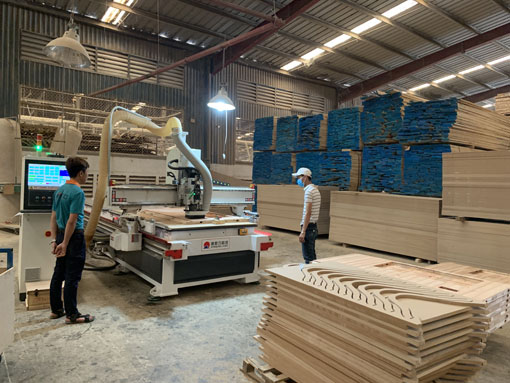
Production activities at Mifaco Wood Processing Company (Thuan An Town)
To understand thoroughly international laws
According to Pham Chi Lan, senior economic expert - a member of the Government advisory group, free trade agreements (FTAs), especially Comprehensive and Progressive Agreement for Trans-Pacific Partnership (CPTPP) has the accumulation of experiences, customs, and common practices in the world in business and investment activities, so it will create new frameworks for Vietnam. This is the proactive aspect of Vietnam in integration. These frameworks require Vietnam to improve business environment, investment environment, and also encourage business and investment activities of all economic sectors.
As joining FTAs, regulations on enhancing transparency, facilitating and raising standards of labor and environment for sustainable development of enterprises and the economy of Vietnam, for example, CPTPP will help Vietnam to have opportunities from newly-formed supply chains after the agreement comes into effect. This is an important condition for Vietnam to heighten the level of economic growth. However, Ms. Lan believed that international economic integration always came with risks and challenges. Specifically, Vietnam would have to promptly improve laws and institutions to meet international requirements.
Regarding integration issues, Huynh Quang Thanh, General Director of Hiep Long Company (Thuan An town), said that when FTAs took effect, businesses needed to analyze internal capabilities and study business environment in a comprehensive way to develop plans. In particular, without a strategic plan, businesses cannot build long-term competitive advantages, including opportunities to rise up in the global value chain.
Dien Quang Hiep, Chairman of Binh Duong Wood Processing Association, said that to the wood industry, CPTPP would create opportunities for businesses to expand markets and increase exports. Besides advantages, CPTPP would also pose many challenges to Vietnamese enterprises, that is goods of Vietnam have to meet a lot of strict standards and more technical barriers. For example, Vietnamese goods must comply with the standards of origin, technique, quality, environment and labor according to stricter and more comprehensive criteria; tariff lines will be reduced, Vietnamese furniture would have to compete with furniture from other countries in CPTPP on both domestic and export markets...
To firmly hold the domestic market
Nguyen Thi Lan Phuong, Multilateral Trade Policy Department under Ministry of Industry and Trade, said a big challenge facing our country was the competitive pressure from imported goods of partner countries. In fact, market opening and deep tax cuts under provisions of signed FTAs will be an opportunity for imported goods to increase and compete with domestic goods.
To stand firm on the domestic market and export, Tran Thanh Trong, Chairman of Binh Duong Mechanical and Electrical Association, said enterprises were making efforts to connect with FDI enterprises in Vietnam to find sustainable directions for integration. He also wished to have many opportunities and good conditions to meet mnay domestic and foreign businesses to introduce capabilities of electromechanical companies, thereby meeting the needs of technology partners.
At Seminar on “CPTPP - Opportunities and challenges for timber industry” held by Binh Duong Wood Processing Association recently, Pham Chi Lan said that Vietnam's wood industry should also pay attention to domestic market instead of solely attach importance to export. Currently, the middle and upper classes in the country are growing strongly. Therefore, if timber enterprise ignores domestic market with more than 90 million people, it will be a great waste.
Currently, Vietnamese economy is more open to the world. This is also the time when global brands penetrate deeply into our market. Many experts said that the systematic problem facing most Vietnamese businesses was not lack of ideas, but business ideas had been weakly implemented.
According to multinational professional service network (Deloitte), 70% of Vietnam's population age 15 - 64. This is the main factor that creates an attractive retail market.
Reported by Tieu My – Translated by Ngoc Huynh