


From the beginning of the year, exporting enterprises in the province has gained stable growth with enterprises pending for benefits from Free Trade Agreements (FTAs) that Vietnam is in.
Stable growth
In May -2018, export turnover of the province was estimated at $ 2.012 billion, up 9.8% over the previous month, up 19.6% over the same period last year. A good sign, in May, domestic economic sector exports reached 448.1 million, up 5% over the previous month and up 20.2% over the same period last year. Generally for the first 5 months of 2018, export turnover of the domestic economic sector in the province reached $ 2.021 billion, up 13% over the same period in 2017.
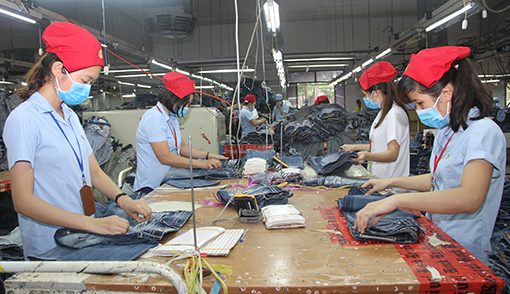
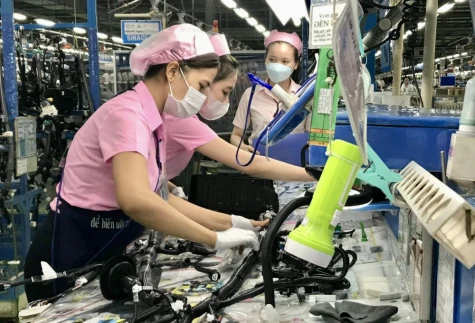
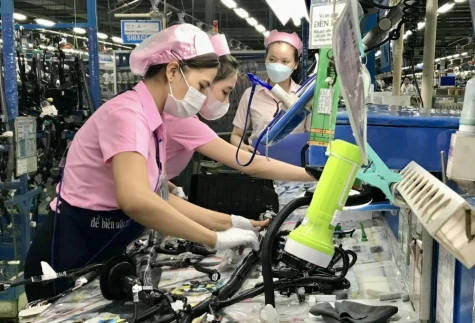
Sản xuất tại Công ty Cổ phần May mặc Bình Dương 1. Ảnh: XUÂN THI
The record shows that in the past five months, export activities of enterprises in general and local enterprises in the province in particular have many advantages. According to the Binh Duong Wood Processing Association (BIFA), the export turnover of members in May 2018 estimated at 223.5 million, up 3.9% over the previous month and up 15, 1% over the same period last year, accounting for 10.3% of total export turnover of the whole province in the month.
Meanwhile, textile and garment exports remained stable and stable. The volume of export orders in the second quarter of 2018 by textile and garment enterprises in the province increased from 3 to 5% over the same period in 2017. For the footwear industry, in the last 5 years, exports of enterprises The province has grown quite well in most major export markets such as Europe, USA, Japan, Korea, some Middle East countries. Most footwear export orders have been up by the end of the second quarter of 2018, with export orders increasing by an average of 5% over the same period in 2017.
According to Huynh Quang Thanh, Chairman of BIFA, in 2018, wood enterprises have many advantages and new markets. The majority of businesses have orders by the end of the third quarter of 2018. Hopefully, with many FTAs being signed by Vietnam, Binh Duong wood industry will continue to grow.
Statistics of the Import-Export Department of the Ministry of Industry and Trade show that up to now, the markets that Vietnam has joined the FTA have recorded high growth rate of import-export turnover compared to the time before the FTA. Textile and garment are one of the most effective uses of FTAs for export growth. Specifically, Vietnam-Korea FTA, effective in 2015, has helped our textile and garment exports to Korea in 2016 reached $ 2.6 billion, up 9.5%; in 2017 reached 2.9 billion, up 11.8% over the previous year. The FTA between Vietnam and the Eurasian Economic Coalition, effective from October 2016, has also helped increase our textile and apparel exports to Russia from US $ 84.8 million in 2015 to about US $ 172 million a year. 2017.
Favorable conditions well used
The Government instructed ministries and sectors to strengthen the development of supporting industries to increase the localization rate, meeting the rules of origin of FTA-participating markets with Vietnam; To further facilitate the enterprises, such as shortening the time of issuance of certificates of origin of goods (C / O), reviewing and simplifying the C / O issuance process, applying electronic C / O declaration, expansion of C / O pilot through internet. The Government also requested the ministries and branches to implement and apply the self-certification mechanism of origin; Continue to reduce the criteria of self-certification to create more favorable for enterprises to participate in this mechanism.
In the coming time, Vietnam's import and export activities are expected to continue to flourish. In order to make the most effective use of Vietnam's FTAs, the Ministry of Industry and Trade will continue to organize wide dissemination of FTA preferences. According to Nguyen Van Danh, director of the Department of Industry and Trade, the participating FTAs are expected to bring new vitality to Vietnamese goods as they are not subject to import tax; The regional market is therefore more open. But the challenge is domestic goods will also be fierce competition, not eliminate the loss of domestic market for goods from abroad. In order to take advantage of the real opportunity from the FTA, exporters must firmly grasp the rules of origin, ensure the right to enjoy incentives. Domestic firms need to intensify their market research, products in FTA member economies.
According to Danh, enterprises have to restructure, transform the growth model in the direction of improving competitiveness. In addition, in order to boost exports, enterprises need to first identify export strategies and proper market strategies. On the basis of market selection and identification of key export items, enterprises should select the mode of production technology and management technology to be suitable. Export goods must meet the standards required by the importing country.
Reported by Tieu My – Translated by Vi Bao