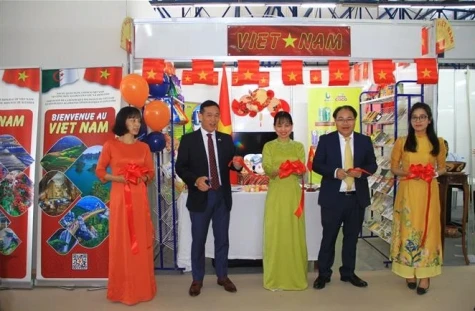



The Philippine newswire the Inquirer has recently published an article highlighting Vietnam as an economic dynamo which offers three helpful lessons for regional peers.
Richard Heydarian, political analyst and non-resident fellow from the Stratbase (ADRi) and the author of the article, affirmed that the first, and arguably most important, lesson from Vietnam is its emphasis on basic education, especially math and sciences.
Though Vietnam is still a relatively poor country, it was first included in the Programme for International Student Assessment (Pisa) by the Paris-based Organisation for Economic Co-operation and Development.
This means that Vietnamese students beat the bulk of their counterparts from wealthy nations in terms of basic proficiency in math and sciences, as well as in reading comprehension, he said.
He went on to hail the second lesson from Vietnam, which is the optimal mix of agricultural and industrial development. Instead of excessively relying on the service sector as in India and the Philippines, or extractive industries as in Indonesia, Vietnam has simultaneously developed into an agricultural and manufacturing powerhouse.
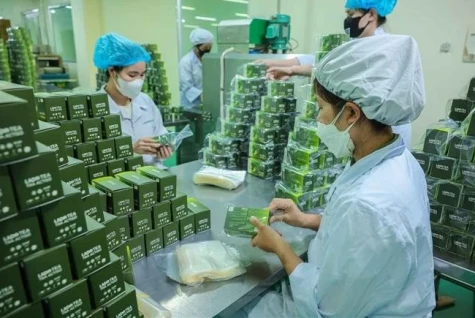
Thanks to its proactive trade, industrial, and agricultural policies, the Southeast Asian country has grown to become among the largest exporters of staple foods, such as rice, as well as high-value-added electronics. Its export-oriented economy even managed to record economic growth in 2020, the same year that the Philippine economy endured an almost double-digit contraction, which was among the worst in Asia.
The country’s effective population management coupled with its diversified economy also explains relatively low incidents of poverty and hunger compared to its peers such as the Philippines. Though still seemingly rural, major Vietnamese cities are also bereft of mind-boggling inequalities, which can be clearly seen in the large slums of Manila, Jakarta, and Bangkok.
The expert outlined that the third lesson from Vietnam is its unique approach to the outside world. Indeed, it has “globalized” and has been able to open itself up to the world under the Doi Moi economic reforms. This has been done without compromising its authentic social values, vibrant food culture, and distinct architecture.
Moreover, the country has proactively cultivated robust economic relations with both the West, finalising free trade pacts with the United States, Canada, Australia, and Europe, as well as with the East, from Japan and the Republic of Korea to India and Russia, he noted.
Heydarian assessed that although on a humbler scale, the rapid Vietnamese ascent is no less impressive with the country transforming in every single dimension of collective life over the past decade.
Whereas scooters had previously dominated local roads, now German cars, sports utility vehicles, and locally-made cars have become common sights in Hanoi and Ho Chi Minh City. What’s particularly noteworthy is the sheer number and elegant designs of cars by the VinFast automotive company, which was only established in 2017 by local billionaire Pham Nhat Vuong.
Earlier this year, the Vietnamese company announced plans to establish a US$4 billion factory complex in North Carolina in order to produce electric vehicles. Facing uncertainty in China, global tech giants are striving to switch production to the Vietnamese market. Recently, Apple announced plans for Macbook and Apple Watch products to be manufactured, via Luxshare Precision Industry and Foxconn, in Vietnam for the first time in history.
Today, almost every branded product from fashion, such as Armani Exchange, to sports, such as Adidas, and electronics, such as Samsung, carries the “Made in Vietnam” tag. For a country that had previously grappled with decades of devastating warfare throughout the latter half of the 20th century, this represents nothing short of transformational, he noted.
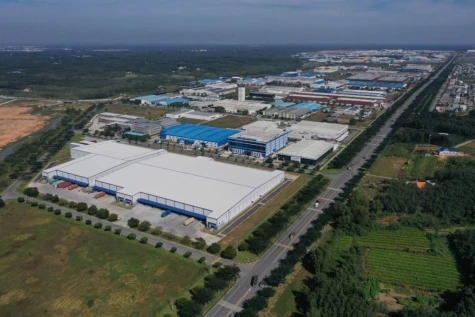
Elsewhere, Christopher J. Marriott, CEO of Savills Southeast Asia, said Vietnam is widely regarded as an outstanding investment destination for high-value manufacturing, particularly as its production capacity satisfies international investors.
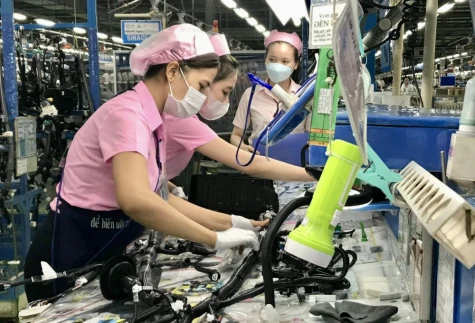
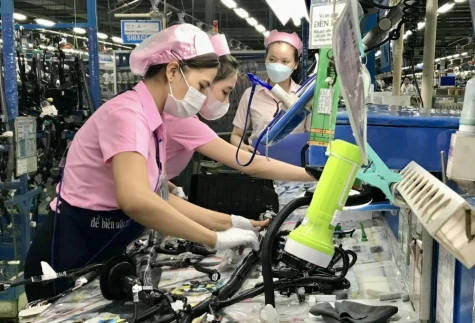
He stressed that the Vietnamese processing and manufacturing industry is being driven by a skilled workforce. Currently, production and logistics costs for the import and export of goods in the country are at an attractive level, with import-export activities also becoming more convenient thanks to the improvement of logistics networks.
According to details given by the experts, investment costs in Vietnam are ideal compared with regional peers, adding that the local workforce has a positive working attitude and is highly qualified.
They pointed out that Ho Chi Minh City and Hanoi are both large cities which specialise in the production of high-end technology and electronic products, a factor which will provide the foundation for developing technological and electronics fields, thereby attracting more investors in logistics and real estate and improving production efficiency and economic development.
VOV/Inquirer