


For the building of a smart city, Binh Duong strives to become a province with strong competitiveness to attract, develop and retain talents in science and technology to promote innovation, research, and develop.
Education in the 4.0 Revolution
Resolution No. 29-NQ /TW on “Basic and comprehensive renewal of education and training to meet the requirements of industrialization and modernization in the socialist-oriented market economy and international integration" pointed out the guideline "Renewal in every level and field of study ". In the renewal process, it is necessary to inherit and promote achievements, develop new ones, selectively absorb the world's experiences; shift the education process from mainly equipping knowledge to comprehensive development of capacity and quality of learners, coupled with practicing; theory coupled with reality...
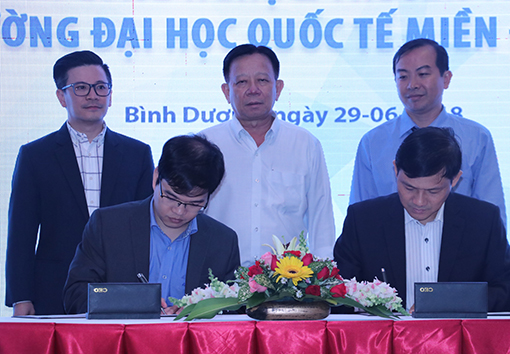
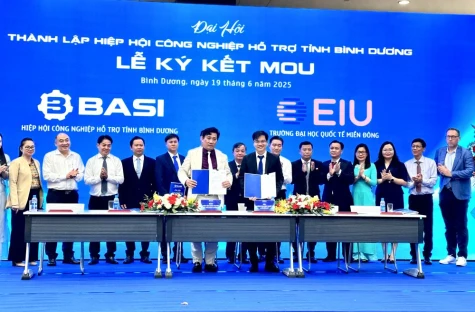
The signing ceremony of cooperation agreement between Vietnam Technology and Communication Joint Stock Company and Eastern International University.
From the application of achievements of the 4.0 Revolution, many industrial sectors have been automated and replacing people, increasing the demand for highly qualified human resources. This requires universities to pay more attention to interdisciplinary teaching, research and innovation. At present, the core of the 4.0 Revolution is the development of artificial intelligence, internet connection, robots, nanotechnology, biotechnology...
According to Do Thi Y Nhi, an economics lecturer of Thu Dau Mot University, education in the 4.0 Revolution is a complicated, dialectical method that was designed to meet the need for a change to corresponding manufacturing. As a result, higher education should focus on: how lecturers teach (teaching methods); how students learn; what lecturers teach; how is the study space; the role of lecturers; the role of students; attributes of lecturer/student. These are the issues that create changes of education after every revolution. The innovation factor in university model is that educational institutions are not limited to traditional training, but are oriented towards entrepreneurship. A university of innovation is not limited to one country; but due to the current trend of integration, universities must increase the level of internationalization.
In order to maximize benefits of investment, these activities should focus on areas most relevant to industries and services with high content of knowledge and technology. The first step of this activity, between Eindhoven city (Netherlands) and Binh Duong, is to exchange students and researchers of topics related to smart city.
In addition, according to experts, relevant parties need to study the feasibility and identify international partners to start training programs of master and doctorate in universities. To create an international competitive environment in the future, where creativity and research are the key, universities in Binh Duong should expand their master's and doctoral training with priority given to fields developing manufacturing, services and industries that would grow in the future. At the same time, mobilizing resources through international cooperation is an important condition for universities to seek funds and to prepare for these programs; Encourage standardization and improve the quality of higher education, in which the cooperation and finding solutions to policy and budget support help universities in the area to build programs according to international standards, such as ABET (for engineering), AACSB (for business), EQUIS...
It can be said that meeting accreditation criteria of ABET or AACSB not only creates the foundation for improving the quality of education but also helps universities in Binh Duong ranked in high-quality universities in the world. Another issue is the need to integrate work skills into curricula of all education levels; linking vocational schools and universities with regional companies; opening FabLab, Techlab and Creative Space (MakerSpaces) ... These innovative spaces can be employed to serve teaching purposes, promote startups, assist small businesses in the process, and is also a location for exchanging talents between schools and businesses.
At present, provincial education institutions that are able to be associated with the national program consist of 45 vocational schools cooperating with local companies. In the beginning stage, universities and colleges according to foreign models with good materials and infrastructure, and the potential to attract enterprises, are prioritized for this program.
Preparing high-quality human resources
For the implementation of the project "Binh Duong Smart City" according to Triple Helix model, Vietnam Technology and Communications Corporation (VNTT) and Eastern International University (EIU) held a signing ceremony of cooperation agreement between the two parties. The content of the cooperation was mainly in training, research and exchange of lecturers - students. According to the agreement, EIU will conduct researches, develop, supply products as required by VNTT. In the cooperation process, VNTT will receive students and lecturers, who want to practice, take internship in facilities of VNTT.
Giang Quoc Dung, Chairman of Directors Board and CEO of VNTT, said that the cooperation between EIU and VNTT helped improve the role of EIU and VNTT in implementing the project "Binh Duong Smart City". This cooperation will bring good changes in the training of high quality human resources to meet development needs of enterprises. This was also a combination to solve problems in technology, management, create new products, contributing to sustainable development for enterprises.
Previously, VNTT and Vietnam NTT signed a business cooperation contract to build FTTH system and ICT solutions. The signing ceremony was to specify the content of MOU signed by the Becamex IDC and NTT Group (Japan) with the purpose of jointly studying the feasibility of building and developing smart city in Vietnam, especially in Binh Duong New City.
Mr. Ii Motoyuki, Deputy General Director of NTT EAST (Japan), President cum CEO of Vietnam NTT, added that after this project, the two sides would continue another project to pilot Smart Education in Binh Duong province to bring more convenience, meet needs in the new development stage of people and businesses in the area.
Reported by Phuong Le – Translated by Ngoc Huynh