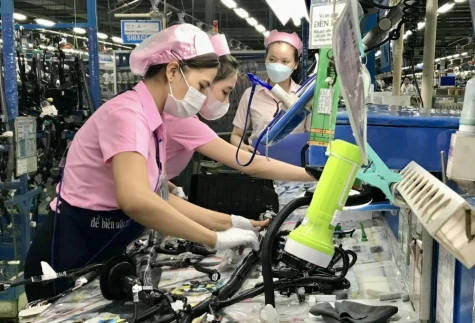



Decades-old technologies are widely used across most sectors, keeping the country from becoming more competitive in the global market.
Vietnam’s backwardness in technology is dragging down its economic growth.
As the country is trying to leave its mark in the global economy, it has no other option but to move up the value chain and away from the traditional low-wage, low-tech model.
There has been some success. Statistics show that high-tech products contributed 28.7% in the country’s gross domestic product in 2013, up from 19.1% in 2012 and 11.7% in 2011. The goal is to bring this ratio to 45% by 2020.
 |
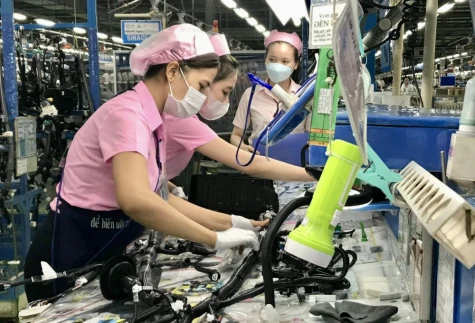
| Laborers work to make Zara jackets at a garment factory in Bac Giang province, near Hanoi October 21, 2015. Photo by Reuters/Kham |
The government seems to be fully aware of the importance of technology in manufacturing. It has been pushing for the adoption of modern machinery and production methods in both labor-intensive industries that make garments, shoes or furniture, and capital- and technology-intensive sectors such as automobile and electronics.
Over the past five years, the Vietnamese government has invested about VND10 trillion (US$450 million) in technology and science. And since 2001, it has consistently set aside about 2% of the annual state budget, or 0.5% of the GDP, to introduce scientific and technological advances to various industries.
Despite all these efforts, Vietnam is still 50 to 100 years behind the most modern countries in the world in terms of technology, according to the Ministry of Science and Technology. Compared to the world’s average level, its technology is between two and three generations, or 20 years to 30 years, behind.
The country’s support industries, which urgently need technological advances to boost productivity, remain weak, said Pham Tuan Anh, deputy head of Heavy Industries Department under the Ministry of Industry and Trade.
Enterprises in these industries currently account for only 0.03% of the country’s total number of businesses. The lack of local suppliers has forced Vietnam to import nearly 90% of raw materials, spare parts and components.
Domestic companies in support industries can only meet about 10% of the demand, Anh added.
Data show the ratio of locally sourced components in automobile manufacturing is ranging from 20% to 30%. For textiles and garments as well as footwear, it is around 10%.
Local garment companies have to import more than 65% of raw materials, including fabrics and other accessories from overseas, especially from China, which owns the bulk of the world’s polyester production and is one of the top producers of cotton, said Le Quoc, a senior advisor to the Vietnam Textile and Garment Association.
Support industries are currently controlled by foreign-invested companies, mainly from Japan, the Republic of Korea and Taiwan.
Official figures show about 80% of parts suppliers in Vietnam, including electronic and other metal parts, are foreign companies.
The Vietnamese government has worked on a plan to change this.
The goal is that in the next four years local support industries will have 1,000 suppliers that can meet 45% of the manufacturing sector’s demand. By 2030, there will be 2,000 suppliers that meet 70% of the demand.
In its drive for modernization, the country is also forecast to import machinery and equipment worth US$250 billion between 2011 and 2025.