


The first Dialogue Conference of customs - Korean enterprises 2018 was upgraded to a new level of content with the participation of Customs Counselor of Korean Consulate in Ho Chi Minh City along with leaders of Korean Business Association investing in Binh Duong.
To better effects
At the first Customs-Korea Business Dialogue Meeting (I-2018), the organizers prepared the documents focusing on three main contents: New points in Decree 59/2018 / ND-CP. of the Government and Circular No. 39/2018 / TT-BTC of the Ministry of Finance providing for import and export taxes; Warning about common mistakes to guide enterprises to comply with the law and answer questions and concerns of enterprises during the process of customs procedures. These contents are briefly arranged in a set of 60 pages in both Vietnamese and Korean, in line with the Korean reading culture, which is horizontal rather than vertical.
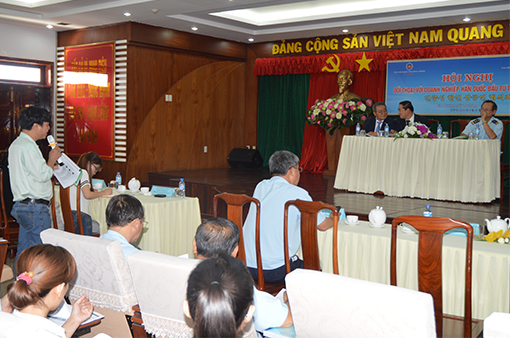
Representative of Korean businesses presents his questions at the conference. Photo: Duy Chi
The participants in this conference also changed in the direction of more in depth and responsibility. Specifically, the previous conference, diplomatic representatives are usually Consul General, Consulate, State Secretary of Commerce ... now the Korean Consulate General has appointed a specialist with knowledge Specialized in Customs - Yang Seung Hyuk, Consul General of the Korean Consulate General in Ho Chi Minh City.
Currently Binh Duong Customs Department is carrying out procedures for 396 Korean enterprises, accounting for 8% of the total number of enterprises doing procedures at the unit. From the beginning of the year to June 15, 2018, export turnover of the Korean business community in Binh Duong reached over USD 2.5 billion, accounting for 13.2% of the total export and import turnover through Binh Customs Department. Ocean. The state budget revenue of the unit reached 6.172 trillion dongs, of which the Korean business community was 419.6 billion dong. In 2017, Korean business community contributed 5.02% of total revenue of Binh Duong Customs Department; In the first 6 months of 2018, it rose to 6.8%. This figure shows the efficiency of production and business of the business community in the province, together with the investment environment, the reform of administrative procedures continues to promote effectiveness and effectiveness.
Coordination of customs-investors elevated
As President of the Korean Business Association in Binh Duong, Park Jin Ku affirmed that, through the dialogues, law dissemination will give member enterprises a great deal of and very useful knowledge. With that understanding, there is no difficulty that is not resolved quickly, accurately. So, the questions that the business raised here will help us improve the knowledge, improve the efficiency of work.
At the conference, a series of questions were asked by representatives of Korean enterprises, but most of the problems did not occur in Binh Duong Customs. For example, the following questions: "When the customs dossier is loaded with yellow or red stream, the enterprise needs to supplement the paper; Our company makes customs declarations for chemical shipments in other cities, the customs office requires the production of such MFDF (chemical safety information sheet) as true; The cost of producing is not required, but other provincial customs force us to do so, so that it is not in accordance with the regulations".
Regarding the issues mentioned above, the representative of Binh Duong Department of Customs said that Article 8, Circular 39/2018 / TT-BTC of the Ministry of Finance stipulates that enterprises submit dossiers under electronic mode. For gold flow, red flow, issuance of certificates of origin (C / O), enterprises can supplement by electronic forms or paper records, as long as the elements. The dossiers shall comply with the provisions so that the customs offices shall consider them. For MFDF paper, which is a chemical safety information sheet, what information is needed to keep the carrier in a safe place. This form does not fall under the mandatory requirements of the customs file. Similarly, processing fees are not mandatory when carrying out customs procedures.
Around the subject of Mr. Yang Seung Hyuk, Customs Counselor of the Korean Consulate in Ho Chi Minh City - co-chaired the meeting, cited: Analysis of commodity classification under Circular 39/2018 / TT-BTC Is the Ministry of Finance different from the previous regulations? Duong Hong Hanh, Deputy Director of Binh Duong Customs Department, said that the new point in the analysis of goods classification in accordance with Circular 39 / 2018 / TT-BTC of the Ministry of Finance is the determination of commodity codes in advance; Compared with previous regulations, enterprises are entitled to submit dossiers in advance and add the following goods codes. As such, when enterprises need information on commodity codes, enterprises must wait for the requirements in the dossier to come later. To deal with such inadequacies, Circular 39 clearly stipulates that enterprises must classify goods 60 days in advance; the rest remains unchanged.
Regarding the recommendations of enterprises, according to Mr. Hanh, there will be some situations as follows: If enterprises meet difficulties and obstacles in Binh Duong Customs, enterprises reflect, recommendations at the place of procedures. If entangled in mechanisms and policies, enterprises may directly report to the General Department of Customs, the Ministry of Finance. If any obstacles in the law of enterprises can be reflected to the Government.
Nguyen Phuoc Viet Dung, Director of Binh Duong Customs Department, said that in order to improve the coordination between the customs authorities and Korean investors in Binh Duong province, help Korean investors to understand the policies. to expand investment and listen to the comments of Korean investors on difficulties and obstacles when carrying out customs procedures, Binh Duong Customs Department, in coordination with the Association of Korean enterprises in Binh Duong, held this conference to timely propagate a number of important legal documents related to import and export activities, help businesses better understand and comply with the rules as well as timely solving problems and obstacles in the implementation of the new rules.
Reported by Duy Chi – Translated by Vi Bao