


In 2018, many free trade agreements (FTAs) entered into force in Vietnam, opening up many opportunities for domestic businesses. However, supporting industries in the province in particular and the country in general do not meet the demand for materials for manufacturing enterprises. Without cooperation with foreign invested enterprises, domestic enterprises will find it difficult to participate in the global supplying chain.
To increase nationalization ratio at the soonest
In 2017, the export turnover of the whole province increased by 17.6% compared to 2016 and is forecasted to increase sharply in 2018. The result is obvious; however, the leaders of the wood enterprises in the province said that in the year their real profit was not high as the demand for supporting materials continuously increased (increased by 20% compared to the previous year). In fact, wood materials account for a relatively high proportion of the cost of wood products (averagely 20-30%), while most of the raw materials supporting the current production is supplied by importation. Luong Ngoc Kim, Director of Kim Thanh A Co., Ltd said that every year, wood enterprises in the province spend hundreds of millions of dollars on auxiliary materials, such as screws, paints, varnishes, and sanding paper. This is provided by importers for distribution in the Binh Duong market.
In 2018, the garment industry is expected to grow at a good rate. According to Binh Duong Textile and Garment Association, up to this stage, many large-scale garment enterprises in the province have orders until the end of the second quarter, even some enterprises have orders for the whole of 2018 although most businesses are concerned about the unit price, because garment is trending down in many markets around the world. Meanwhile, the textile and garment industry of Vietnam is facing many problems such as the increasing cost of raw auxiliary materials, low added value and competitiveness of many businesses in the current trend. From now on, to integrate and meet the needs of customers, businesses need to participate in the supply chain of gradually increasing the localization rate and more sources of raw materials.
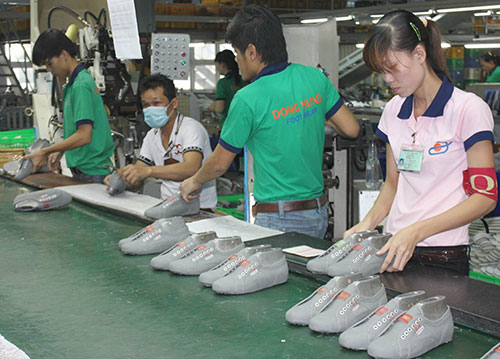
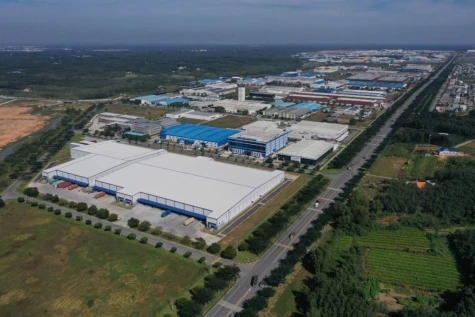
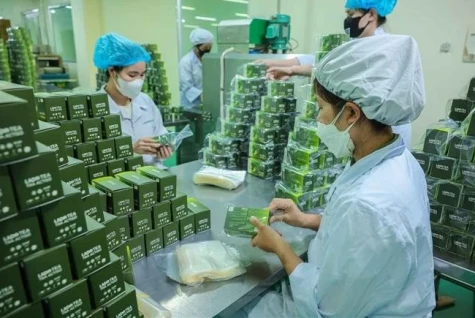
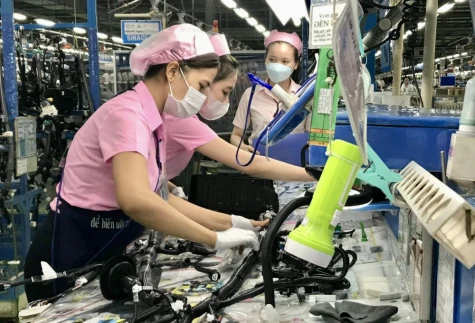
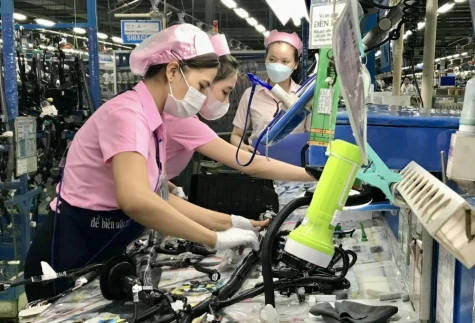
Supporting industrial development plays a major role of industrial development in the province. In this photo: Shoes are produced at Dong Hung Industrial JSC in Di An Town. Photo: Tieu My
Deputy Minister of Industry and Trade Cao Quoc Hung said that the weak point and the main reason for the low value-added domestic textile and garment industry is that the garment supply chain has not yet been developed. Global supply chain requires each step to meet the best quality, good price and delivery time. To overcome these shortcomings, the government and ministries are gradually removing difficulties, issuing mechanism and policies to develop supporting industries, including industrial products. This helps to develop the supply chain in the textile and garment industry of Vietnam.
To create linkage of domestic and foreign enterprises
Implementing the Decision No. 2751/QĐ-UBND dated November 26, 2011 of the provincial People's Committee on "Approving the scheme of orienting development of supporting industries in Binh Duong province up to 2020", Binh Duong authority has been trying to build a long-term strategy for supporting industries, creating momentum for other industries to develop.
At present, foreign enterprises involved in the development of supporting industries are available. At the end of 2016, KOLON signed a Memorandum of Understanding with the province on the implementation of a US$ 1 billion tire and airbag plant project on an area of 42 hectares in Bau Bang industrial zone. According to the plan, investors will invest US$ 220 million in Phase I of 2017-2018, US$ 600 million in Phase II of 2018-2026 and then Phase III. Project of Binh Duong Tetra Park Joint Stock Company (Singapore) with registered capital of US$ 124 million in Vietnam - Singapore II Industrial Park, specializes in manufacturing sterile paper packaging from plastic, aluminum to pack food. The development of auxiliary industry has initially formed the linked production between domestic enterprises and foreign enterprises, creating conditions for domestic enterprises to step by step access public advanced technology and join the global value chain industry.
However, Binh Duong's supporting industry products are mainly produced by foreign investors, while domestic enterprises are developing slowly, with small scale and limited capital capacity, technology, and production. Most of the domestic supporting industry enterprises have not yet joined the supply chain of foreign enterprises operating in Vietnam.
Explaining the lack of linkage between domestic and foreign enterprises, experts said that domestic enterprises have not met the requirements of quality, price and delivery time of foreign enterprises. Domestic enterprises are mainly small and medium sized so the ability to meet the requirements of quality standards of partners is limited.
According to economic experts, Vietnam wants to develop a sustainable industry, there is no other way to focus on developing supporting industries, which is the basis for sustainable industrial development. For domestic supporting industries, it is necessary to link with foreign invested enterprises to learn how to design, manufacture and acquire technology sources.
Reported by Tieu My – Translated by Vi Bao