


Next: Part 2: Neo-effective methods
Starting up as a province of poverty, agriculture-dependent economy, and rough traffic roads, Binh Duong Province has emerged as a locality of leading development in the nation. To gain such achievements, Binh Duong Provincial leading authority has timely grasped up the needs and expectations of the public while creatively implementing the decisions and doctrine of the Party and the State regarding economic development, i.e., promotion of internal forces and gather of external forces to develop the economy. Traffic development is the contributing factor to such economic achievements.
When the Party’s decisions meet the public expectations
In 1997, Binh Duong Province is split from the former Song Be Province to an area of 2,716.01 square kilometers and a population of 600,000. At the time, economy in Binh Duong Province has mainly been developed in the South of the province where plenty of foreign investments have been lured into. In the meantime, the Northern part of the province has been dependent on agriculture and the public live hood has been of great challenges due to poor traffic system which has been so insufficient to travelling and business needs. Statistically, Binh Duong Provincial Department of Transportation showed that only 1,823 kilometers of rural traffic system and 142 bridges of totally 1,649 meters were present.
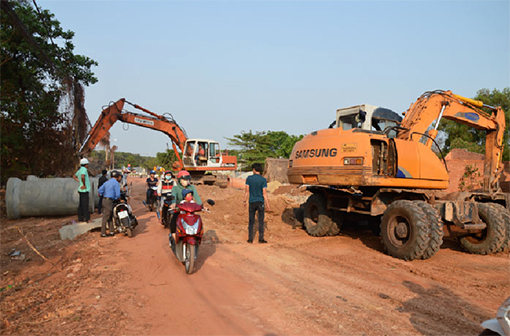
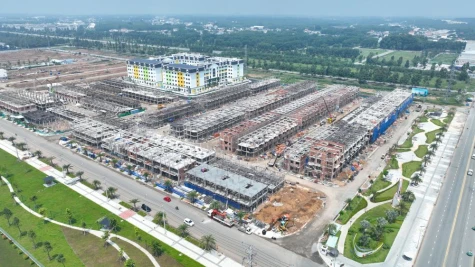
Traffic construction is on-going along with urban justification in Thu Dau Mot Town. Photo: D. Chi
Resolving the mentioned challenges, Binh Duong Provincial People’s Committee issued Directive No. 07/1998/CT-UB dated April 7, 1998 on promotion of rural traffic road construction and urban area justification. Implementing the Directive was to intrigue and exploit the available potentials and to promote socio-economic development both in rural and urban areas. Concurrently, the movement of rural road construction and urban area justification was initiated by the motto of “joint efforts of the State and the public”.
Implementing the Directive of Binh Duong Provincial People’s Committee, the movement of rural road construction connecting communes and wards to quarters and hamlets, interconnecting hamlets and farms, alleys has been emerged. Despite great challenges and obstacles, the constructions of rural roads and urban area justification have been more and more year on year. This affirmed the truth that decisions made by Binh Duong Provincial People’s Committee have been righteously made to meet the public expectations. Accordingly, the traffic system has been established to interconnect localities and change the appearance of rural and urban area, creating foundation for acceleration towards industrialization and modernization of the province.
In 1998 alone, 602 constructions of rural traffic and urban justification covering 427 kilometers, in the first year of movement initiation, were established in the province. Of the mentioned scale, 524 road constructions covering over 420 kilometers were upgraded; 22 bridges covering 313 meters were upgraded and repaired; 56 constructions of urban area justification were implemented. Total expenses was over VND 6 billion. As far as ranking was concerned, the former District of Tan Uyen led the list with 223 constructions before Thuan An 213 constructions, Ben Cat 106 constructions, and Thu Dau Mot Town 60 constructions.
Strong traffic development
After 10 years of implementation, the province has totally 6,265 constructions of rural traffic and urban area justification covering 3,874 kilometers at the cost of over VND 461 billion.
The righteous decisions and policies of Binh Duong Province in the movement of rural traffic constructions and urban area justification have created new rural appearance of the province, facilitating the changes of agricultural production structure. Accordingly, various farmers have switched from individual to farm husbandry in various forms. They have also changed their production mean to machinery and scientific advancement application, eliminating manual work. The traffic infrastructure covering urban areas to rural areas has enabled Binh Duong Province to successfully implement the industrialization and modernization.
Summing up 10 years of rural traffic constructions and urban area justification, Nguyen Thi Kim Van, the former Chair of Binh Duong Provincial People’s Committee and the person directly in charge of the then movement, concluded: the movement of rural traffic constructions and urban area justification has contributed to the refinement of traffic road network from the provincial level to communal ones and from the urban areas to rural ones; this promoted economic development and improved the public live hood particularly in rural and remote areas for the success of Binh Duong Provincial Party Committee’s action plan on implementation of Resolution No. 15-NQ/TW of the fifth Congress of the ninth tenure Executive Central Committee of CPV on boosting industrialization and modernization of agriculture and rural areas.
To cherish today’s infra-construction, Binh Duong Provincial localities have been always promoting the motto of “joint efforts of the State and the public”, calling upon donation of local enterprises into rural traffic constructions. The above achievements have contributed to creation of attractive investment environment, facilitating emergence of modern industrial parks for the development of key economic sectors in the province.
Economic development motivation
Summing up 10 years (1998-2007) of the movement of rural traffic construction and urban area justification, Department of Statistics informed of over VND 1.3 billion yield of agricultural production with 105.6% gain of the planning. In 2006, surplus value of the sector has reached VND 5.8 billion with over 105% of planning achievements. Agricultural production, in 1998, indirectly brought up VND 6.5 billion of surplus value with 117.2% of the year planning. In 2002, the numbers were VND 31.1 billion and 140.2% accordingly. In 2006, the same numbers stood at VND 112.4 billion and 125.1% accordingly.
Evaluating the effects of rural traffic construction and urban area justification on local socio-economic development from 1998 through 2007, Mr. Dang Van Ba, the then Deputy Chair of Thuan An District People’s Committee, affirmed that no traffic connection would have be established unless the movement were in place. Thanks to the movement, local people have enjoyed more favored travelling and business operations. Meanwhile, Mr. Nguyen Van Nghia, Deputy Chair of Di An Town People’s Committee was straightforward to consider the movement as the beautifying tool. As a result, the town has been developed by the modern urban-industrial-service orientation.
To be continued: Party 2: Neo-effective methods
Reported by Duy Chi – Translated by Vi Bao