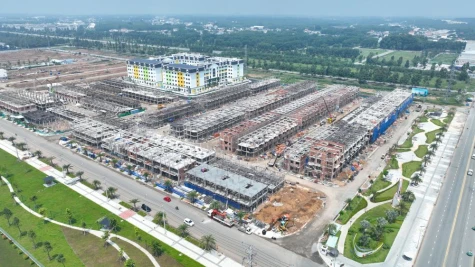



 A bird view on Ho Chi Minh Trail nowadays
Then, the Americans jumped in to replace the French colony and their henchmen.
In the rice harvesting season late 1959, each team (except for the leading scouts) was sent to the farms to meet local people.The ethnic community kept their secrets and in the first steps, the teams had built up core staff in many villages.When the rice harvesting season came to its end, our forces had organized the elimination of thugs in many villages and communes.American henchmen of Diem authority knew about revolution activities, thus, opened the front raids across the region, but mainly on the Highlands Plateau of R'But resettled by M'nong BiReh ethnic people.
The B4 team expanded missions of eliminating spies allocated under the invaders' scheme.To succeed in doing so, the officers and soldiers kept staying with local people and getting accustomed to their foods and lifestyle.
In the meantime, revolutionary organizations were built in the public to uprise against the then Americans and Diem authority.
By the end of June 1960, B4 team disclosed directive of the Politburo of Central Committee of the Party to allow B90 team to open the route through Southern region before the dry season of 1960 while informing the meeting with Team 1 at Rung Village; however, the situation was not suitable then.
Team 1 leader, Tran Quang Sang proposed a scouting team to cross Dak R'Tih River to Western area of Gia Nghia town to connect with the Southern groups.
When the scouting team of Pham Van Lac headed to the Dak R'Tih River, it was July 1960 when the flooding season was at it height.Pham Van Nhuong and Nguyen Van Dinh headed back to Busanar to get additional rice supply.Pham Van Lac, Hoang Minh Do, and Tran Van Thoi stayed at the river bank to investigate for way of crossing the river.Tran Van Thoi, the youngest, healthiest and most cunning member, volunteered to cross the river.
Pham Van Lac accepted as being convinced by Thoi's enthusiasm and urgent mission. However, Thoi was pushed to a whirlpool which stripped off his lifeguard tying ropes.He was distressed calling for help but the current was too powerful and he was pulled away.
The scouting team of D1 lost an aggressive, determined and brave soldier who was a teamate and beloved brother.
By September 1960, the B4 convened and summoned all its scouts to the site to evaluate the situation and revolutionary movements as well as to plan for expansion. A funeral was held for memorial of Nguyen Van Thoi while the scouts were pending for news from the South
At the beginning of October 1960, B4 Team informed that the Union 200 in charge of opening up routes from the South had arrived at Busaya Village region near Dak R'Tih River together with secret recognition signals. When successfully connected, the Union 200 was secretly sent to Southern Highlands to investigate the routes as the way the ethnic people did.On searching their map the group was almost near Bugur original destination; however, they had to cross the river to the other side.They succeeded in crossing the river after one member was near dead by the current for his efforts saving the radio equipment. Gathering all the members, they got to the highest end of Bugur - the meeting point.
Fortunately, despite being grouped up, villagers of Bugur left behind a bunker of rice and salt.It was decided by the team that the rice and salt were temporarily bought in the absentee of the owners, they took 20 bags and left the money in the bunker.
Through the radio, the team knew that the North Group had reached to Busaya area.Continuing to seek for them; however, the could not meet anyone at Busaya.Searching the surrounding, they met a group M'Nong Ma tribe not gathered by the enemy.With the very first contact, the villagers had known of revolutionists, thus, they were delighted to welcome them.By night fall, the villagers killed swine to invite their guests with pork and pipe drinking wine.
But the next morning, the villagers required the soldiers to move to the forest to stay away from enemy's spying. From the village base, the scouts searched for traces of the team from the North.Seeking along the river bank to a fork of flows, they discovered the traces of cooking stoves and hammock poles, carefully camouflaged.However, they found the place desserted and returned to report the scouting while identifying the location of Dak R'Tih River on the map where the team should camp to wait for the team from the North.On October 30, 1960, while the scouting team was cooking, the scouting team of Pham Van Lac had returned to the destination. Discovering the place was occupied but the got the hunch of their teammates.Thus, the meeting was overjoy with embraces and tears of those soldiers sacrificing themselves to build up the legendary roads.
Eating up the fish soup, the two teams returned to the forest Busaya - the base of Union C200. And, they spent a jubilant night with stories from the North and South retold .
The meeting was to open up marching routes and building a long cause of revolutionary success.The Street No. 1 through Southern Highlands to the South region was through.
Reported by Nguyen Huynh – Translated by Vi Bao
A bird view on Ho Chi Minh Trail nowadays
Then, the Americans jumped in to replace the French colony and their henchmen.
In the rice harvesting season late 1959, each team (except for the leading scouts) was sent to the farms to meet local people.The ethnic community kept their secrets and in the first steps, the teams had built up core staff in many villages.When the rice harvesting season came to its end, our forces had organized the elimination of thugs in many villages and communes.American henchmen of Diem authority knew about revolution activities, thus, opened the front raids across the region, but mainly on the Highlands Plateau of R'But resettled by M'nong BiReh ethnic people.
The B4 team expanded missions of eliminating spies allocated under the invaders' scheme.To succeed in doing so, the officers and soldiers kept staying with local people and getting accustomed to their foods and lifestyle.
In the meantime, revolutionary organizations were built in the public to uprise against the then Americans and Diem authority.
By the end of June 1960, B4 team disclosed directive of the Politburo of Central Committee of the Party to allow B90 team to open the route through Southern region before the dry season of 1960 while informing the meeting with Team 1 at Rung Village; however, the situation was not suitable then.
Team 1 leader, Tran Quang Sang proposed a scouting team to cross Dak R'Tih River to Western area of Gia Nghia town to connect with the Southern groups.
When the scouting team of Pham Van Lac headed to the Dak R'Tih River, it was July 1960 when the flooding season was at it height.Pham Van Nhuong and Nguyen Van Dinh headed back to Busanar to get additional rice supply.Pham Van Lac, Hoang Minh Do, and Tran Van Thoi stayed at the river bank to investigate for way of crossing the river.Tran Van Thoi, the youngest, healthiest and most cunning member, volunteered to cross the river.
Pham Van Lac accepted as being convinced by Thoi's enthusiasm and urgent mission. However, Thoi was pushed to a whirlpool which stripped off his lifeguard tying ropes.He was distressed calling for help but the current was too powerful and he was pulled away.
The scouting team of D1 lost an aggressive, determined and brave soldier who was a teamate and beloved brother.
By September 1960, the B4 convened and summoned all its scouts to the site to evaluate the situation and revolutionary movements as well as to plan for expansion. A funeral was held for memorial of Nguyen Van Thoi while the scouts were pending for news from the South
At the beginning of October 1960, B4 Team informed that the Union 200 in charge of opening up routes from the South had arrived at Busaya Village region near Dak R'Tih River together with secret recognition signals. When successfully connected, the Union 200 was secretly sent to Southern Highlands to investigate the routes as the way the ethnic people did.On searching their map the group was almost near Bugur original destination; however, they had to cross the river to the other side.They succeeded in crossing the river after one member was near dead by the current for his efforts saving the radio equipment. Gathering all the members, they got to the highest end of Bugur - the meeting point.
Fortunately, despite being grouped up, villagers of Bugur left behind a bunker of rice and salt.It was decided by the team that the rice and salt were temporarily bought in the absentee of the owners, they took 20 bags and left the money in the bunker.
Through the radio, the team knew that the North Group had reached to Busaya area.Continuing to seek for them; however, the could not meet anyone at Busaya.Searching the surrounding, they met a group M'Nong Ma tribe not gathered by the enemy.With the very first contact, the villagers had known of revolutionists, thus, they were delighted to welcome them.By night fall, the villagers killed swine to invite their guests with pork and pipe drinking wine.
But the next morning, the villagers required the soldiers to move to the forest to stay away from enemy's spying. From the village base, the scouts searched for traces of the team from the North.Seeking along the river bank to a fork of flows, they discovered the traces of cooking stoves and hammock poles, carefully camouflaged.However, they found the place desserted and returned to report the scouting while identifying the location of Dak R'Tih River on the map where the team should camp to wait for the team from the North.On October 30, 1960, while the scouting team was cooking, the scouting team of Pham Van Lac had returned to the destination. Discovering the place was occupied but the got the hunch of their teammates.Thus, the meeting was overjoy with embraces and tears of those soldiers sacrificing themselves to build up the legendary roads.
Eating up the fish soup, the two teams returned to the forest Busaya - the base of Union C200. And, they spent a jubilant night with stories from the North and South retold .
The meeting was to open up marching routes and building a long cause of revolutionary success.The Street No. 1 through Southern Highlands to the South region was through.
Reported by Nguyen Huynh – Translated by Vi Bao
Part 2: Determination to open up the trail
The French resistance war of the Vietnamese people over 9 years of 1945-1954 was just a turning point on the way to victory. Southern Highlands and South East settlement areas of ethnic minorities have not been released from the enemy lines while the North-South communication was blocked. Southern Highlands people were ready to protect the corridor after the Geneva Treaty, most of southern revolutionary forces were gathered to the North leaving just thin forces behind.
A bird view on Ho Chi Minh Trail nowadays
Then, the Americans jumped in to replace the French colony and their henchmen.
In the rice harvesting season late 1959, each team (except for the leading scouts) was sent to the farms to meet local people.The ethnic community kept their secrets and in the first steps, the teams had built up core staff in many villages.When the rice harvesting season came to its end, our forces had organized the elimination of thugs in many villages and communes.American henchmen of Diem authority knew about revolution activities, thus, opened the front raids across the region, but mainly on the Highlands Plateau of R'But resettled by M'nong BiReh ethnic people.
The B4 team expanded missions of eliminating spies allocated under the invaders' scheme.To succeed in doing so, the officers and soldiers kept staying with local people and getting accustomed to their foods and lifestyle.
In the meantime, revolutionary organizations were built in the public to uprise against the then Americans and Diem authority.
By the end of June 1960, B4 team disclosed directive of the Politburo of Central Committee of the Party to allow B90 team to open the route through Southern region before the dry season of 1960 while informing the meeting with Team 1 at Rung Village; however, the situation was not suitable then.
Team 1 leader, Tran Quang Sang proposed a scouting team to cross Dak R'Tih River to Western area of Gia Nghia town to connect with the Southern groups.
When the scouting team of Pham Van Lac headed to the Dak R'Tih River, it was July 1960 when the flooding season was at it height.Pham Van Nhuong and Nguyen Van Dinh headed back to Busanar to get additional rice supply.Pham Van Lac, Hoang Minh Do, and Tran Van Thoi stayed at the river bank to investigate for way of crossing the river.Tran Van Thoi, the youngest, healthiest and most cunning member, volunteered to cross the river.
Pham Van Lac accepted as being convinced by Thoi's enthusiasm and urgent mission. However, Thoi was pushed to a whirlpool which stripped off his lifeguard tying ropes.He was distressed calling for help but the current was too powerful and he was pulled away.
The scouting team of D1 lost an aggressive, determined and brave soldier who was a teamate and beloved brother.
By September 1960, the B4 convened and summoned all its scouts to the site to evaluate the situation and revolutionary movements as well as to plan for expansion. A funeral was held for memorial of Nguyen Van Thoi while the scouts were pending for news from the South
At the beginning of October 1960, B4 Team informed that the Union 200 in charge of opening up routes from the South had arrived at Busaya Village region near Dak R'Tih River together with secret recognition signals. When successfully connected, the Union 200 was secretly sent to Southern Highlands to investigate the routes as the way the ethnic people did.On searching their map the group was almost near Bugur original destination; however, they had to cross the river to the other side.They succeeded in crossing the river after one member was near dead by the current for his efforts saving the radio equipment. Gathering all the members, they got to the highest end of Bugur - the meeting point.
Fortunately, despite being grouped up, villagers of Bugur left behind a bunker of rice and salt.It was decided by the team that the rice and salt were temporarily bought in the absentee of the owners, they took 20 bags and left the money in the bunker.
Through the radio, the team knew that the North Group had reached to Busaya area.Continuing to seek for them; however, the could not meet anyone at Busaya.Searching the surrounding, they met a group M'Nong Ma tribe not gathered by the enemy.With the very first contact, the villagers had known of revolutionists, thus, they were delighted to welcome them.By night fall, the villagers killed swine to invite their guests with pork and pipe drinking wine.
But the next morning, the villagers required the soldiers to move to the forest to stay away from enemy's spying. From the village base, the scouts searched for traces of the team from the North.Seeking along the river bank to a fork of flows, they discovered the traces of cooking stoves and hammock poles, carefully camouflaged.However, they found the place desserted and returned to report the scouting while identifying the location of Dak R'Tih River on the map where the team should camp to wait for the team from the North.On October 30, 1960, while the scouting team was cooking, the scouting team of Pham Van Lac had returned to the destination. Discovering the place was occupied but the got the hunch of their teammates.Thus, the meeting was overjoy with embraces and tears of those soldiers sacrificing themselves to build up the legendary roads.
Eating up the fish soup, the two teams returned to the forest Busaya - the base of Union C200. And, they spent a jubilant night with stories from the North and South retold .
The meeting was to open up marching routes and building a long cause of revolutionary success.The Street No. 1 through Southern Highlands to the South region was through.
Reported by Nguyen Huynh – Translated by Vi Bao
A bird view on Ho Chi Minh Trail nowadays
Then, the Americans jumped in to replace the French colony and their henchmen.
In the rice harvesting season late 1959, each team (except for the leading scouts) was sent to the farms to meet local people.The ethnic community kept their secrets and in the first steps, the teams had built up core staff in many villages.When the rice harvesting season came to its end, our forces had organized the elimination of thugs in many villages and communes.American henchmen of Diem authority knew about revolution activities, thus, opened the front raids across the region, but mainly on the Highlands Plateau of R'But resettled by M'nong BiReh ethnic people.
The B4 team expanded missions of eliminating spies allocated under the invaders' scheme.To succeed in doing so, the officers and soldiers kept staying with local people and getting accustomed to their foods and lifestyle.
In the meantime, revolutionary organizations were built in the public to uprise against the then Americans and Diem authority.
By the end of June 1960, B4 team disclosed directive of the Politburo of Central Committee of the Party to allow B90 team to open the route through Southern region before the dry season of 1960 while informing the meeting with Team 1 at Rung Village; however, the situation was not suitable then.
Team 1 leader, Tran Quang Sang proposed a scouting team to cross Dak R'Tih River to Western area of Gia Nghia town to connect with the Southern groups.
When the scouting team of Pham Van Lac headed to the Dak R'Tih River, it was July 1960 when the flooding season was at it height.Pham Van Nhuong and Nguyen Van Dinh headed back to Busanar to get additional rice supply.Pham Van Lac, Hoang Minh Do, and Tran Van Thoi stayed at the river bank to investigate for way of crossing the river.Tran Van Thoi, the youngest, healthiest and most cunning member, volunteered to cross the river.
Pham Van Lac accepted as being convinced by Thoi's enthusiasm and urgent mission. However, Thoi was pushed to a whirlpool which stripped off his lifeguard tying ropes.He was distressed calling for help but the current was too powerful and he was pulled away.
The scouting team of D1 lost an aggressive, determined and brave soldier who was a teamate and beloved brother.
By September 1960, the B4 convened and summoned all its scouts to the site to evaluate the situation and revolutionary movements as well as to plan for expansion. A funeral was held for memorial of Nguyen Van Thoi while the scouts were pending for news from the South
At the beginning of October 1960, B4 Team informed that the Union 200 in charge of opening up routes from the South had arrived at Busaya Village region near Dak R'Tih River together with secret recognition signals. When successfully connected, the Union 200 was secretly sent to Southern Highlands to investigate the routes as the way the ethnic people did.On searching their map the group was almost near Bugur original destination; however, they had to cross the river to the other side.They succeeded in crossing the river after one member was near dead by the current for his efforts saving the radio equipment. Gathering all the members, they got to the highest end of Bugur - the meeting point.
Fortunately, despite being grouped up, villagers of Bugur left behind a bunker of rice and salt.It was decided by the team that the rice and salt were temporarily bought in the absentee of the owners, they took 20 bags and left the money in the bunker.
Through the radio, the team knew that the North Group had reached to Busaya area.Continuing to seek for them; however, the could not meet anyone at Busaya.Searching the surrounding, they met a group M'Nong Ma tribe not gathered by the enemy.With the very first contact, the villagers had known of revolutionists, thus, they were delighted to welcome them.By night fall, the villagers killed swine to invite their guests with pork and pipe drinking wine.
But the next morning, the villagers required the soldiers to move to the forest to stay away from enemy's spying. From the village base, the scouts searched for traces of the team from the North.Seeking along the river bank to a fork of flows, they discovered the traces of cooking stoves and hammock poles, carefully camouflaged.However, they found the place desserted and returned to report the scouting while identifying the location of Dak R'Tih River on the map where the team should camp to wait for the team from the North.On October 30, 1960, while the scouting team was cooking, the scouting team of Pham Van Lac had returned to the destination. Discovering the place was occupied but the got the hunch of their teammates.Thus, the meeting was overjoy with embraces and tears of those soldiers sacrificing themselves to build up the legendary roads.
Eating up the fish soup, the two teams returned to the forest Busaya - the base of Union C200. And, they spent a jubilant night with stories from the North and South retold .
The meeting was to open up marching routes and building a long cause of revolutionary success.The Street No. 1 through Southern Highlands to the South region was through.
Reported by Nguyen Huynh – Translated by Vi Bao