


Vietnam has the potential to become a leader in tax reform, said Johan Langerock, tax policy expert of Oxfam at the Vietnam Fiscal Policy and Development Forum 2019, which opened in Hanoi on November 13 with scientists, managers, policy-makers, and business representatives in attendance.
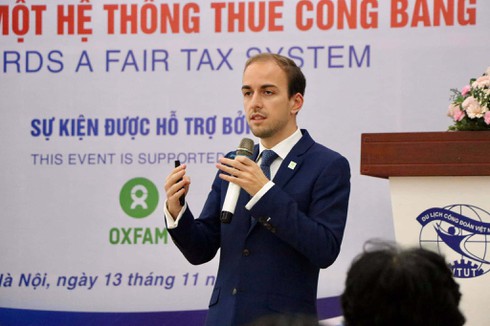
Johan Langerock, tax policy expert of Oxfam
Upon addressing the forum themed “Towards a Fair Tax System", Langerock noted that the country’s economic growth reached a 10-year high of 7.1 per cent last year, with this strong economic momentum expected to continue for the remainder of the year.
The nation has been transformed from one of the world’s poorest countries that suffered from frequent food shortages, to a lower middle-income economy that is currently a leading exporter of rice, seafood, coffee, and other commodities.
The official poverty rate has fallen from 58 per cent in the early 1990s to less than 10 per cent today.
Despite this success, the country’s extraordinary economic track record has not been accompanied by a similar pathway in tax revenue. Most notably, compared to the size of the economy, tax revenues nationwide have been decreasing in recent years.
Langerock believes that in the long term this could pose a danger to the sustainability of the country.
He noted that decreasing tax revenues represent a concerning trend for several reasons. Mainly, it means that the tax system is failing to collect and redistribute created income and wealth in the country.
Several reports already indicate that the benefits of the nation’s economic growth are increasingly going to the wealthiest 10 per cent of the population.
According to the Oxfam representative, one of the biggest factors causing a decrease in tax revenue is the focus on lowering corporate income tax rates, along with the existence of many tax incentives that are in place for foreign investors.
This means that while revenues decrease, tax expenditures have remained high. As a result, export-led industrialization has seen significant development, at the expense of growth among agricultural and small businesses.
It is therefore inevitable that tax expenditure policies have contributed to the country’s economic growth, boosting investment in the process.
However, it must be contemplated that now is the time for the nation to rationalise tax expenditures that are placed on large companies.
Up until now, Vietnamese authorities have not been paying enough attention to performing efficient or effective analysis of tax expenditure policies. The social cost of tax expenditures remains too large to be ignored.
According to the OECD, the revenue loss stands at an estimated 1 per cent of GDP, representing a staggering amount of over VND50 trillion.
This amount could potentially finance 25 new 1000-bed hospitals nationwide. When tax revenue collection on large companies falls, either pressure to levy higher VAT rates on ordinary citizens increases, or fewer public services are delivered.
Langerock expressed his belief that the nation could get rid of its largest tax incentives without growth or competitiveness suffering.
According to a recent survey conducted by Grant Thornton on private equity prospect nationwide, 69 per cent of replies consider the increase in disposal income and middle-income classes as the most important factor for investing in the country.
Furthermore, 60 per cent consider high and stable economic growth, whilst only 13 per cent consider government incentives and subsidies as the most important factor.
The Oxfam representative said ASEAN countries are pushing one another into an aggressive race to the bottom in terms of corporate taxes.
Regional firms have seen their tax rates lower over the last decade. In such an environment, only large companies and wealthy shareholders win at the expense of essential public services for ordinary citizens.
He also recommended the Vietnamese authorities can proceed in two ways, noting that some tax incentives should be eliminated following an impact assessment.
In addition, as the chairman of ASEAN in 2020, Vietnam should make it a priority to raise awareness, in addition to debating the issue of tax competition and tax incentives at a regional level. Both steps should lead to an increase in tax revenue in both a fair and equitable way, according to the Oxfam tax advisor.
He pointed out that this will lead to inequalities decreasing whilst the Government will have more resources to invest in health, education, and the fight against climate change.
At the forum, representatives from the General Department of Taxation and Vietnam Institute for Economic and Policy Research (VEPR) also delivered in-depth reports on tax expenditure in Vietnam.
They also gave some recommendations for the Government in order to use tax incentives effectively within the context of a budget deficit and high public debts.
VOV