


At present, the development of vocational school and enterprise connection in training skilled human resources meeting the needs of enterprises is an indispensable trend.
Enterprises need skilled labor
Binh Duong is a province with a thriving industry in the country. Labor force in industries is abundant and labor quality is increasing. In Provincial Competitiveness Index (PCI) ranking in 2016, Binh Duong was ranked fourth, up 21 levels compared to 2015, corresponding to an increase of 4.98 points. The highest increase was the unofficial expense index (up 1.34 points), labor training (up 0.75 points). According to experts, in order to catch up with the development pace of the province, in the coming time, functional branches should step up the implementation of breakthrough mechanisms and policies on human resource training with a stress on vocational training programs linked to reality.

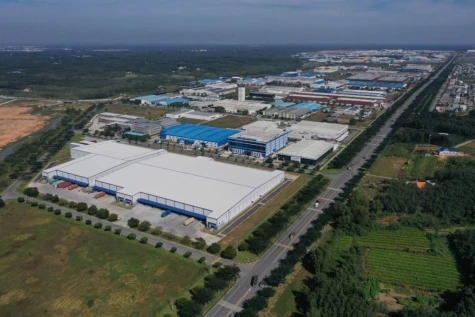
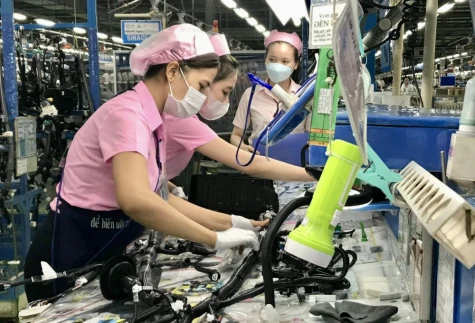
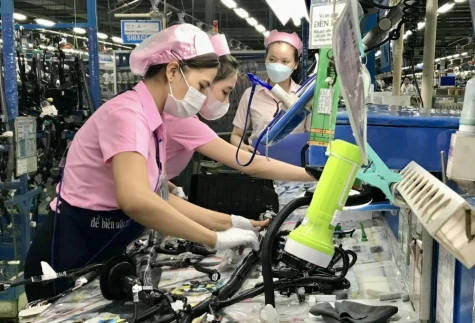
Enterprises believe that in the coming time, the labor market in the province would develop synchronously, high quality. In photo: Manufacturing activities of TPR Vietnam Company (VSIP 2A).
In fact, the demand for skilled labor of enterprises in all industries is very high. However, businesses still find it difficult to find skilled workers. Tran Anh Vu, Director of Lien Thanh Company, said that wood processing sector was an example. Labor productivity in this sector has not improved significantly, while wage costs and employee premiums have been increasing.
Ms. Phan Le Diem Trang, Vice Chairwoman of Binh Duong Textile Association, said that the current training program of schools and the actual production needs of enterprises still had many gaps. Labor of textile and apparel industry is both redundant and deficient, especially design and management personnel. The textile and garment industry is still facing difficulties in terms of low labor stability, labor discipline, awareness and working style of workers. In fact, most workers come from remote areas, where have an agricultural production style; thus they do not strictly comply with rules of time and behavior. Many workers are even not equipped with knowledge, skills to work ... With such situations, this is not a small challenge to the textile and garment industry of Binh Duong in particular and the country in general.
Training must be associated with the needs of enterprises
According to research announced in 2016 by Institute of Science, Labor and Social Affairs, more than 91% enterprises in the country have difficulties in recruiting technically skilled workers; Only 20% of respondents have regular cooperation with training institutions, but the main mode of cooperation is support and reception of trainees, while other forms, like training program creation or sending workers to training institutions is very limited.
As a proposed solution for the textile industry, Ms. Trang said that schools needed to closely link with companies when developing training programs. This would help students after graduation can practice immediately, avoiding the situation that most employers have to retrain after recruitment.
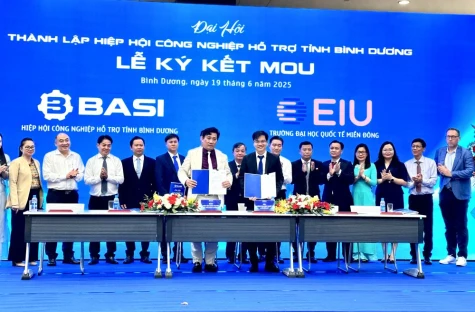
A good sign is that in June, Binh Duong Furniture Association (BIFA) worked with Southern Vocational College of Technology and Agriculture Forestry to cooperate in training qualified human resources for the wood processing industry. Accordingly, the college issued training programs linked to production activities of enterprises. In the coming time, the college and BIFA will organize a vocational training workshop to link training with job creation for students after graduation. When students receive internships, businesses will pay wages as well as binding requirements for students to have higher responsibilities towards their work. On the side of college, professional staff will be assigned to closely monitor production activities of enterprises to follow the actual situation and then adjust training programs for students. In addition, the college and BIFA will set up a board that play the role to link the two sides and help students accessing modern machinery and advanced production technology.
From the aforementioned way of BIFA, it can be seen that responsibility of enterprises towards human resource training, through participation in the development of vocational training, increased investment in human resources in general and direct training in particular, is very large. Enterprises also expect functional sectors to create conditions for a close link between professional training and production activities to create high quality workforce.
Hopefully, with determination and synchronous policies of provincial Party and government, together with the synergy of enterprises and vocational schools, in the coming time, the labor market in the province would develop synchronously, and ensure high quality human resources to meet development needs of the province.
According to the Department of Labor, Invalids and Social Affairs, the province has 7 vocational universities, 14 colleges, schools, 10 vocational education centers and 35 registered vocational education establishments.
Reported by Tieu My – Translated by Ngoc Huynh